
What was evaluation season like before talenx?
We managed everything in spreadsheets, and it was genuinely hectic. Back then we couldn't run multi-rater reviews — only first- and second-line manager reviews and job/competency assessments. With 160 people and a structure where each employee is assessed by around 12 raters, a single department head ends up involved in at least 12 evaluations, so across 160 people you generate thousands of spreadsheet files. Collecting and managing them all took about two months. Working in spreadsheets also invited mistakes, and those mistakes made it hard to run evaluations properly.
Out of all the options, what was the decisive reason you chose talenx?
There was a gathering where HR managers from LS Cable's affiliates and partners shared how they run things, and that's where I first heard about talenx. Afterward I compared several SaaS and on-premise solutions, and talenx stood out the most in terms of UI. We had first built our job and competency framework through workplace-innovation consulting, and we needed a flexible structure that could hold that framework in the system.
After actually adopting talenx, where did you feel the biggest difference on the ground?
The evaluation cycle changed the most dramatically. With spreadsheets, collecting thousands of files took nearly two months — about 60 days. Now, once I upload the data, it wraps up in a week and a half, about 10 days. My part is basically just uploading. And being able to run multi-rater reviews properly is itself a huge change. Before, the files were so massive we couldn't even attempt it; now everything is set up by job group and level.
| Before talenx | After talenx |
| Only first-/second-line manager reviews possible; no multi-rater review | Company-wide multi-rater review by level and job group |
| Thousands of spreadsheets collected; evaluation season took about 2 months | Cut to 1–1.5 weeks after data upload |
| Frequent typos and mis-entries eroding evaluation reliability | Errors minimized through system automation |
| Performance evaluation run alone (attendance · org · HR separate) | Integrated expansion into Org · HR · Attendance modules |
The change is clear for the administrator — but how did the employees running and receiving evaluations react?
The response was much better than with spreadsheets. People were a little unfamiliar with it at first, but now in the third year they're handling it smoothly. Raters in particular liked it — with large teams, typos and mis-entries in spreadsheets were fairly common, and those mistakes disappeared once we moved to the system. Being able to trust the results more also raised confidence in the evaluations themselves.
This time you expanded from the performance evaluation module into the Org · HR · Attendance modules — what was the reasoning?
The first reason was to raise adoption of performance management. We figured that if employees log in often to use the attendance module, participation in performance management would naturally rise along with it. The second was integration potential. We reviewed several attendance solutions, but since we were already running performance evaluation on talenx, keeping it all on the same platform was the most sensible choice. Right now, just calculating annual leave and holiday work takes about 200 hours a year, and we expect the modules to cut that in half.
Is there a service experience that stands out to you?
If I send an inquiry email in the morning, I get a reply before lunch. If they sense I might not fully understand something, they even call to walk me through it directly. I've also had UI improvement requests reflected — I asked them to fix a magnifier button that sat awkwardly at the far edge of the screen, and it actually got changed. Seeing my own feedback reflected in the system felt great.
We heard you've shared your talenx experience externally. What kind of occasion was that?
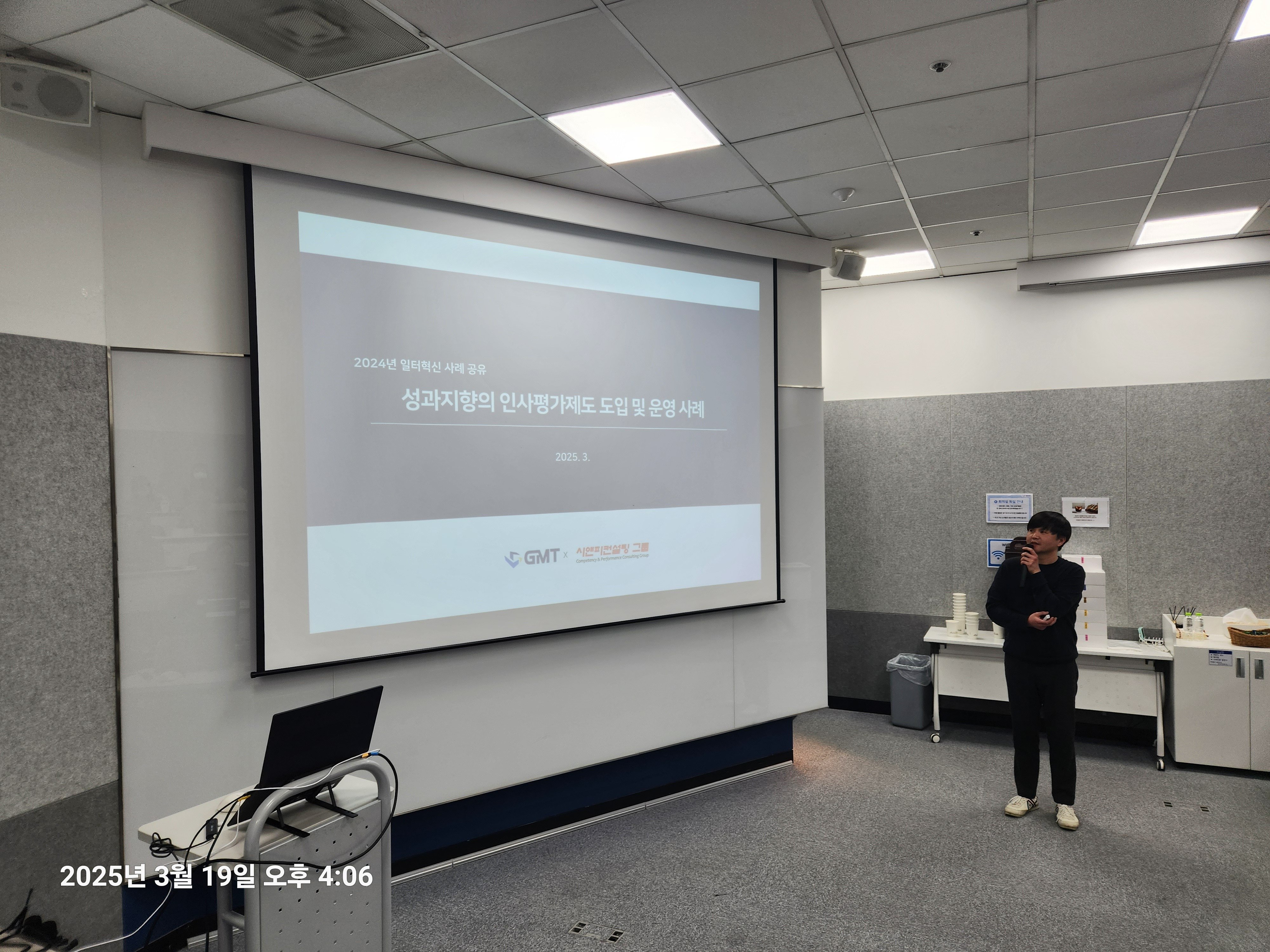
Through the workplace-innovation consulting run by the Labor-Management Cooperation Foundation, we took part for two to three years and were selected as a best-practice case, and at that presentation I also introduced our experience using talenx. I participated twice, in 2023 and 2024, and the final presentation drew HR managers from about 50–60 companies. Most companies in the workplace-innovation program haven't yet built out a proper HR system, so sharing a case built on talenx in front of them drew a lot of interest.
If you had a word for HR managers facing similar challenges, what would it be?
If your company hasn't yet adopted an evaluation system, I'd strongly recommend talenx. The multi-rater feature in particular is excellent, and it seems to fit the IT industry especially well. Unlike manufacturing, where performance shows up clearly in numbers, IT has long development cycles and results that are hard to quantify neatly. Even if it costs something, it's the right call to reduce the administrator's workload. Running it on spreadsheets means spending two months out of the year — and being able to redirect that time to core work like policy-making and organizational culture is, I think, the real value of adopting a system.