
Was there a moment running reviews on the old system when you thought, "this really isn't working"?
In the end it came down to the structural limits of the foreign solution. There were two big ones. The first was speed. Nothing responded immediately when you looked something up, so even checking a single item took ages. The second was implementation limits. Because we couldn't implement the evaluation schemes we run inside the system, there was a huge amount we had to manage by hand. Integrity is everything for review data, but with a structure where people enter it directly, verification alone took more time — and that vicious cycle repeating was the hardest part.
You must have reviewed several solutions — was there a decisive scene that tipped you toward talenx?
It was a period tied to building out our HR system, so the schedule was extremely tight. In that situation, three things mattered most. First was policy fit of the features. Our absolute-evaluation and always-on performance-management schemes all had to be covered on one platform — and talenx fit exactly. A structure that accumulates records and keeps the data unbroken: that was the direction we wanted. Second was interface integration between systems. Being able to connect smoothly with existing infrastructure, including the HR system, was decisive. Third was how the service consultants responded. Their will and follow-through to co-develop the views we wanted to fit our adoption conditions — that became the final reason for our choice.
| Before | After |
| Goal setting · performance management · multi-rater review · final review each run as separate, fragmented programs |
From goals to feedback · multi-rater review · final review, connected on one platform |
| Desired evaluation scheme couldn't be built in the system → manual entry + separate verification effort |
Policy-tailored build, manual work greatly reduced and data integrity secured |
| 360° multi-rater results viewable as a grade only |
Item-by-item report + AI keyword analysis improve employees' self-understanding |
| Unintuitive UI, slow speed → heavy review workload for executives · team leads |
Intuitive UX such as drag-and-drop raises executive · team-lead satisfaction |
| Hard to accumulate always-on performance records |
Work boards · feedback · badges accumulate continuous data year-round |
For the 360° multi-rater assessment, what changed most noticeably in employees' reactions compared with before?
The report format itself changed completely. Before, you could only see your score as a grade; now a report is produced item by item. Being able to compare your score against the overall average intuitively pushed employee satisfaction way up. On top of that we use AI keyword analysis, so employees can read their strengths and areas to improve far more concretely. The key is the shift to a structure where you grasp not just "what score did I get," but "which aspects are strong and where should I grow," on your own.
On the always-on performance management side, what change do you feel most since adopting talenx?
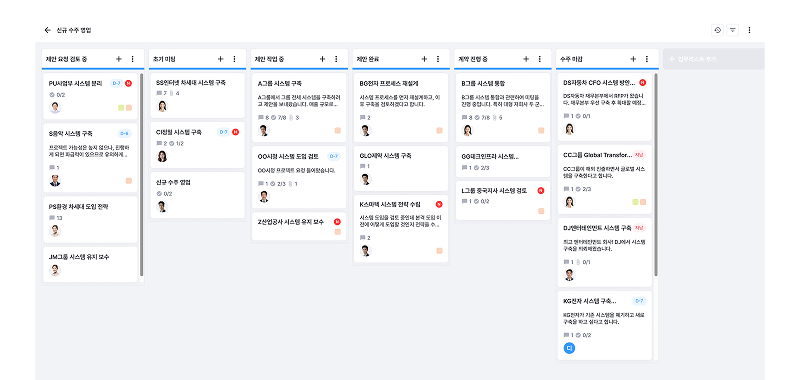
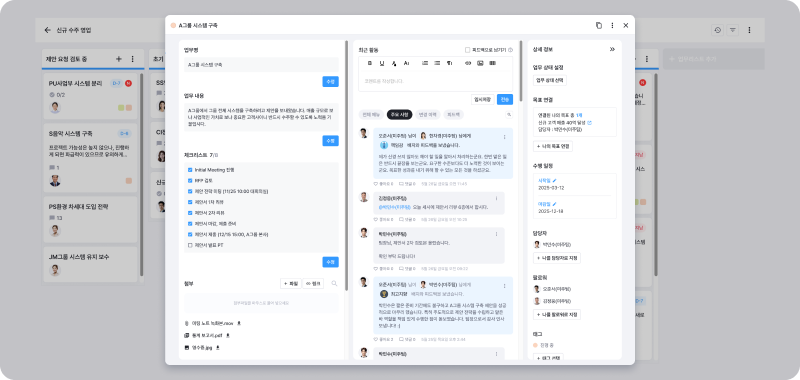
On talenx's work board you can link goals directly to actual work and manage progress. One-on-ones happen inside it too, and feedback exchanges and badges accumulate as one flow — so always-on performance management is now literally run "always-on." Being able to grasp work status anytime without requesting individual reports each time is a big change as well. Before, all of this was separate; now the context connects within one platform, so the quality of performance management itself feels different.
Compared with the foreign solution you used before, when did it feel most different once you actually used it?
To put it in a word: the foreign solution was a platform for producing results, whereas talenx feels like a system that also captures the process of creating those results. Our review lead operated a global foreign solution directly at a previous job, and there goal setting, always-on performance management, multi-rater review, and final review were all separated into different programs. In talenx they're all connected as one, and in terms of cumulative goal management and always-on communication it fits domestic HR trends far better.
You ran several customization projects — which moment left the strongest impression?
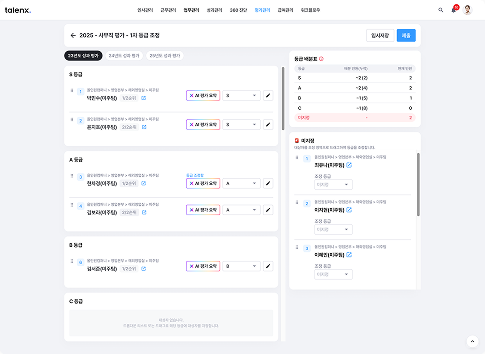
The work on the calibration-session screen — the grade-adjustment feature within reviews — stands out. After adopting absolute evaluation, the calibration session is one of the most critical processes to operate. It was almost the early days of adoption, right? We needed screens and features tailored to our company, and despite an extremely tight schedule they delivered them to a high standard in under a month. Beyond that, the anonymization of 360° feedback, support for implementing job-competency diagnostics, and custom reports in the formats we wanted — everything we requested was reflected. For a SaaS service with so many clients, having our requests handled within the deadline even when many pile up during review season was something I was truly grateful for.
Since adopting talenx, how would you describe what changed in the quality of reviews or the way you operate them?
With a structure where you exchange feedback, accumulate records, and have that connect naturally to the review, it feels closer to the original purpose of evaluation. Before, a review was closer to "an act of producing a result"; now it's a structure where the records and feedback built up over the year are reflected in the review just as they are. It was clearly different in character from a performance-review product built by an ordinary software company. If the foreign solution was a program for producing results, talenx is a platform where the entire process of performance and review connects organically.
If you met an HR practitioner with similar concerns, which kind of company would you recommend talenx to?
If your company wants to run performance management and review schemes deeply and seriously, talenx will fit well. Especially if you want to run feedback properly but have no way to measure it because the records aren't left anywhere, talenx can be the answer.