In a way, the system itself became the limit of how the system could be run.
Exactly. Because it only opened and closed within set periods, communication and feedback weren't free-flowing, and in the end, performing the evaluation labor just to produce a single grade letter — S, A, B, C, D — became the goal in itself. Then, while receiving HR-system improvement consulting, our direction took shape: shift from results-centered to process-centered, and adopt a continuous performance management framework that also raises acceptance of evaluation.
You must have reviewed many solutions, both domestic and overseas. What was the decisive reason you ultimately chose talenx?
With so many job functions mixed together, the goal types break down very differently by function — MBO, IDP, product/technology development goals, common metrics, and more. Amid that variety, talenx had a clear philosophy and direction about what performance management actually is, and on top of that they presented real possibilities for flexible feature development suited to our situation. The fact that the different systems for general roles and research roles could all be implemented within a single platform was also decisive. Most other vendors say, "Just tell us and we'll build it all for you." But honestly, that made us more anxious. talenx came to us with an already-solid architecture, so there was no burden. With overseas systems, a UI that didn't fit Korean sensibilities and the complexity of feature development were obstacles — but talenx had no issues there either. The fact that they already had adoption cases at organizations even larger than Daesang also played a decisive role in our trust and our choice.
We hear your internal security review standards for adopting SaaS are very strict.
That's right. Security was a major hurdle too. Our company's own review standards for security and external networks are very strict, and instead of saying "that can't be done," talenx showed a clear willingness to continuously monitor and respond to the security level we required. They presented cases of large-enterprise clients with even stricter security requirements than ours, and the fact that they hold and maintain top-tier security certifications such as ISO/IEC 27001 and ISMS also gave us grounds to persuade our internal stakeholders.
Changing the system in an organization of 5,000 people is no small task. We're curious about the changes felt on the ground, before and after adoption.
The very structure of performance management changed. We shifted to registering goals, key results, and detailed action plans, with team leads approving each goal individually. Honestly, in the early days there was some friction over the increased number of input fields, but once people actually used it and adapted, each team has been developing its own way of using it.
| Before (foreign solution's evaluation module) | After (talenx) |
| System open only at the three annual process points | Continuous goal management, feedback, and communication |
| Bulk approval of all goals | Individual approval per goal + recorded agreement process |
| Low performance review completion | Performance review completion rose above 95% |
| Performance management = a grade-calculation tool | Expanded into a performance management + competency development tool |
| No visibility into work status without individual reports to the team lead | Real-time status visibility via the work board (PR team case) |
We also run a survey in which reviewees themselves rate how faithfully the performance management process was carried out. The item on whether a review meeting actually took place rose above 95%. We can see in the data that review meetings and ongoing communication have genuinely increased since using talenx.
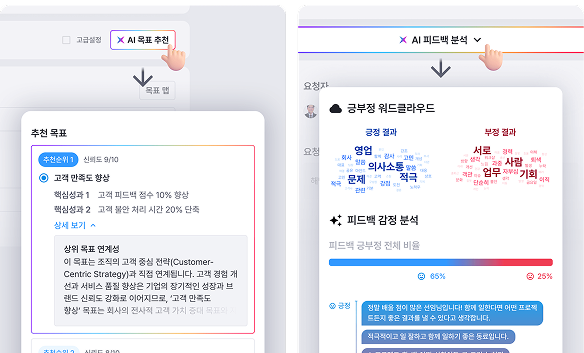
You also adopted talenx's AI goal recommendation feature. What did you pay the most attention to when introducing AI features in your organization?
Again, it was security. There were concerns that confidential information — employee personal data, key results, and goals — might leave the company, so we requested the service architecture and personal-data flow diagram from talenx and verified them ourselves. Only after confirming that just goal and key-result data are processed in encrypted form, and that employee personal data is not included, did our internal security review wrap up. We're now making good use of the AI goal recommendation feature. Our people are already familiar with external AI tools, so expectations run high — and talenx's AI features genuinely lived up to those expectations, raising overall satisfaction with the system another notch.
Besides the performance management module, please tell us about any features you've been using well.
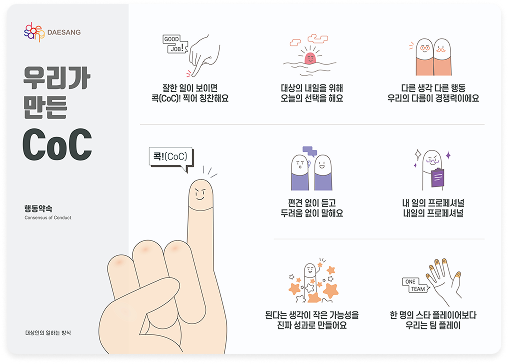
talenx's work board lets you manage goals by directly linking them to actual work. The PR team uses it especially well. On the PR team, each member is responsible for specific media outlets, so they break down each member's work by outlet on the work board; when a member updates their progress, the team lead can check in anytime. It created an environment where individual reports aren't needed every time. talenx also has a feedback badge feature that lets people attach a badge when exchanging feedback. Rather than using it as-is, we created our own badges based on our 10-point Code of Conduct (COC). Because it lets you give feedback that pinpoints "which behavior was practiced well" — beyond simple praise — the response from our people has been great.
Compared with other HR systems, what do you see as talenx's decisive difference?
talenx isn't a product built by developers at a general software company — it was planned and designed directly by HR consultants at a company that specializes solely in HR services. Perhaps that's why the core features are so tightly woven: depending on how an administrator sets it up, there's wide room to apply it in ways that reflect the organization's and the roles' characteristics. The scalability and flexibility to hold both a traditional HR foundation and trend-driven approaches like OKR are built into the system architecture by default. As the saying goes, there may be people who have never used this system, but no one who has used it only once — satisfaction is high once you try it. It's not simply that there are many features; when you actually use it, you can feel that it's a system built by people who understand HR.
When unexpected issues arose during operation, how did talenx respond?
Their response is genuinely fast. When an error occurs, regardless of whether it's fully resolved yet, they always tell us right away that they've recognized the error, by when they'll address it, and an immediate temporary workaround. When we ask, "We'd like to use this feature this way — is it possible?", they always also suggest ways to use existing features differently. They respond so well that we sometimes catch ourselves asking them first instead of looking into it carefully on our own.