

Related Solution
HCG HR Solutions
hunel · JaDE · talenx — we propose the right HR solution for your organization.

Solve Complex HR Challenges with HCG
Talk to our experts
Insights
Everything is digital now. We can no longer talk about the future — or even the present — without AI and mobile, and the only companies that have made it into the upper tier of the global leaders are the ones supplying the core resources and methodologies for digital transformation.
In a world this saturated with the digital, the way people communicate with each other is also changing. They no longer communicate through text and symbols, and even when it comes to video, they rarely sit through a two-hour movie. What they have instead is short-form content that can spike their dopamine far more efficiently in the same amount of time, and rather than taking the time to put a thought into writing, it is more common to snap a photo or record a quick video and post it to Instagram or TikTok.
Digitalization — with its faster communication — has also changed how work gets done. It is no longer the default that everyone gathers in an office to work, and many companies are pouring effort into making it possible to collaborate the same way people use social media on a smartphone.
But some companies seem to think this shift has not actually made employee-to-employee communication any more convenient.
Formidable names like Tesla and Nike have declared that remote work will no longer be "permitted" for their employees, and many Korean companies have also been pulling people back into the workplace, creating considerable friction with employees who had grown accustomed to the new way of working. Employees, for their part, do not seem particularly satisfied with working in their company's digital space.
According to Gartner, only about one-third of employees report the level of experience in their digital work environment as "satisfactory." The reason is simple. Swapping an analog work environment for a digital one — taking the same paperwork people used to do with paper and pen and putting it into a keyboard and monitor — offers employees no real positive experience at all.
For years, many companies approached digital change from the angle of operational optimization — accumulating more data, classifying it effectively, and using it to streamline headcount and physical space. From that angle, DEX (Digital Employee Experience) was outside the field of view.
But the gap between employees' digital experience inside the company and outside of it has kept widening, and that gap has surfaced as dissatisfaction with the internal digital experience.
The internal digital system is no longer just a management tool for improving operational efficiency — it has started to become a virtual collaboration space that brings together employees who are physically apart. Just as we now meet people on a smartphone screen rather than in classrooms, parks, and public squares, for employees, the workplace is increasingly perceived as being inside that virtual system. For that reason, digital communication about work has to resemble digital communication in everyday life — that's what minimizes the sense of "disconnect" employees feel in their workplace communication.
In the previous era, "care" for employees was hard to address systematically — it was treated as a byproduct of "team building" that happened in the office. We relied heavily on the natural vertical and horizontal human relationships that form among colleagues who spend long hours together in the same office.
Today's corporate work environments have moved beyond the simple fact of people being physically separated. They have turned agile, with many cases in which teams are assembled by project rather than by organizational boundary. On top of that, compared with the era when a single company was treated as a lifelong employer, the cycle of joining and leaving has become incomparably shorter. In an environment like this, it is unrealistic to leave "care" for employees to the analog relationships that form over long stretches of shared office time.
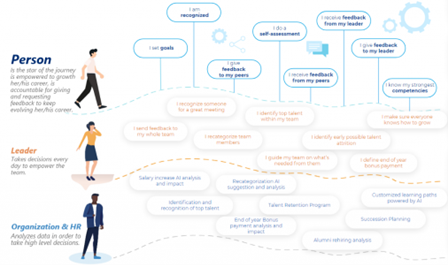
One concept that has recently drawn a lot of attention in digital employee experience is Lifetime Employee Journey management.
Rather than leaving all the communication and care — from the moment someone is hired, assigned, delivers results, grows and gets promoted, up through the day they eventually leave — in the hands of their colleagues, this approach ties everything into the company's integrated HRIS and uses the system to deliver tailored benefits, gifts, and support. It is a way of managing a company's "genuine care" for its employees systematically.
In the short-form era, there is no "formality" in the act of noticing, acknowledging, and praising someone's good work. You simply tap a heart with your finger, and ask the system to keep telling you their news so you can stay closer to them. This is a completely different dimension from the procedural complexity of analog-era activities like 360-degree reviews that tried to collect peer feedback.
Forcing that kind of complexity onto employees while trying to gather more "crowd-sourcing feedback" and then analyze and use it is close to impossible.
That is why collecting peer diagnostic data from employees today demands far higher accessibility, along with fun and genuine communication baked into the process.
This resembles designing an SNS service in many respects, but it differs in how the resulting data is analyzed and used — and, at the same time, in how the design has to promote collaboration among employees. This is a promising area where platform, HR, and data technologies are converging. That convergence will eventually lead to integrated HR platforms in which every area — personnel management, goal management, performance management, attendance and task management, approvals — is handled inside a single "all-in-one" platform, and the data generated from it enables higher-order predictive analytics for workforce management.
To many longer-tenured employees, the company may look like a place that is steadily losing its "human connection." But to digitally native employees, it can feel like the opposite — a place where the system is getting in the way of connection forming in the first place.
Digital HR is no longer just a "desktop" that helps employees get their work done efficiently — it is evolving into something more like a lounge where every member of the company can share a common life experience.