

Related Solution
HCG HR Solutions
hunel · JaDE · talenx — we propose the right HR solution for your organization.

Solve Complex HR Challenges with HCG
Talk to our experts
Insights
When did the traditional five-step job level and title system start to change? The first moves came in the early to mid-2000s, but the change became widespread only after 2015. Over the past several years, digital transformation (DT), generational change (MZ), and the pandemic (Untact) have driven a wide range of innovations as companies responded to these shifts.
As a result, job titles in Korea have moved from the traditional, seniority-based five-step system to a more common streamlined structure grounded in role and capability.
If we summarize the current trend in Korean companies: "Simplify job levels somewhat, but simplify and unify titles even further, in order to promote a flexible, horizontal, creative, and collaborative organizational culture."
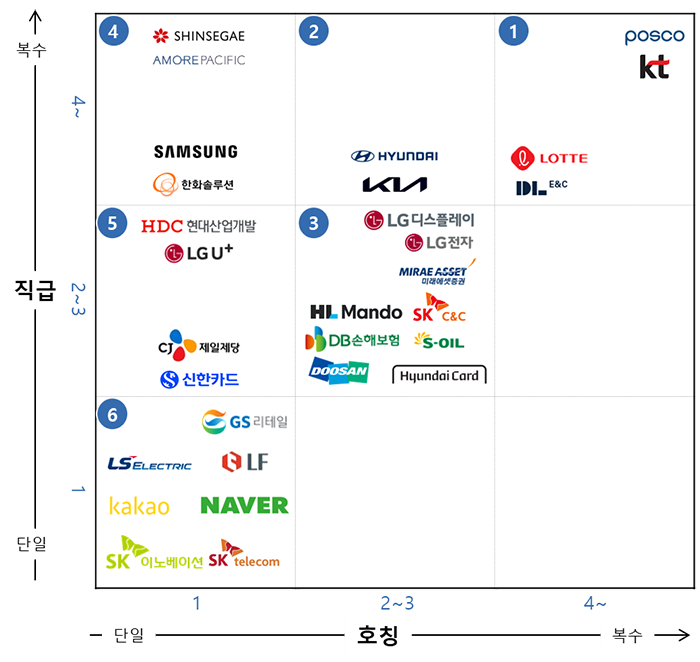
<Figure> shows the current state of job level and title systems at major Korean companies (primarily the top 30). Approaches range widely — from companies that stick with the traditional five-step system (POSCO, KT, etc.) to companies that have taken a dramatic leap to a single level and single title (Naver, Kakao, etc.).
Based on this, the job title systems currently in use in Korea can be broadly grouped into the following six types.
Companies using four or more levels and four or more titles fall into this category, and even within it, some have kept the five-step framework (POSCO, KT, etc.) while others have partially simplified to four steps (Lotte, DL, etc.). These are companies that have either taken a gradual, cautious approach to restructuring job levels, or have tried to simplify their levels and titles and then reverted after running into problems.
Hyundai Motor and Kia are representative examples. Job levels run from G1 to G4 (four steps), but titles are split into just two — "Manager" (G1–G2) and "Senior Manager" (G3–G4) — which appears to acknowledge some differences in employee level while still using job expertise as the foundation for a horizontal working culture.
This may well be the most common pattern today: streamlining to two or three job levels based on role and capability, with titles mapped one-to-one to those levels. Within this group, some companies use three steps (LG Electronics, S-Oil, etc.) and others use two (Doosan, Mando, etc.).
Samsung and Shinsegae fall into this category, and within it, some still use five-level systems (Shinsegae, Amorepacific, etc.) while others use four (Samsung, Hanwha, etc.). What stands out about these companies is that the job levels are differentiated by job role or career level, while the title is unified — "Nim" or "Pro," for example — to emphasize horizontal communication and collaboration among employees.
This pattern dramatically simplifies job levels around role and capability, and simplifies titles even further. Typically, two or three levels are defined by stage: "learning the job" (historically 사원/주임 and the like), "executing as a full contributor" (historically 대리/과장), and "playing a management role" (차장/부장 and above). Titles are unified — "Manager,"
"Nim," etc. — as a single designation.
This is the most dramatic job level and title system in use among Korean companies. It is typically seen in leading, tech-focused companies in fiercely competitive industries. These companies use a single level and title to focus HR on ability and results rather than seniority (i.e., promotions), and to build a flexible organization and culture.
That said, some of these companies are running de facto job levels that are not disclosed externally, or are reviewing internally whether to revert from a single level to a multi-level system — which is worth keeping in mind.
The traditional five-step job level and title system has become so rare that it is hard to find, and simplification has been the dominant direction for quite some time.
In fact, job levels and titles are no longer really at the top of the HR conversation. So does that mean there is nothing much new happening in this area?
Not quite. Looking at today's Korean landscape, the trend can be described as "continuing to review additional simplification toward a job level structure that fits team-based organization, and tying it more tightly to ability and skills." The context behind this is Korea's rapid aging, HR congestion, labor shortages, and the dramatic pace of recent technology change.
As the average age of employees rises and job level structures are simplified, companies are increasingly seeing a "top-heavy" distribution and HR congestion. This has brought with it a loss of organizational vitality, insufficient progress on the horizontal culture that was originally intended, a buildup of high-level employees without management roles, generational conflict, and frustration or attrition among employees who have lost out on promotion and assignment opportunities.
In response, some companies are considering additional simplification of job levels and titles — so that the team concept can actually function as intended, so that more senior employees can still do hands-on work, so that younger, capable employees get more opportunity,
and so that people can work horizontally and creatively once the "rank badges" come off.
① Company A: From 3 Levels to 2
Company A had already simplified its five-step system into three. It originally aimed to build an ability- and performance-based HR system, but as promotion congestion worsened and some paternalistic HR practices lingered, employees remained preoccupied with promotion and unhappy about it. Work ethic among senior-level employees slipped, and mid-tier attrition accelerated.
Company A is now simplifying those three levels into two — "learning" and "execution" — and allowing anyone at or above the execution level to be appointed team lead, so that young, capable employees can put their skills to work more quickly.
② Company B: From 3 Levels to a Single Level and Title
Company B had been running a three-step system, but concluded that the organization still had problems with vitality and efficiency. To raise organizational flexibility and agility, and to strengthen a horizontal culture with better communication and collaboration, it moved to a single level and single title. At the same time, to meet the MZ generation's expectation of recognition and reward every year, the company has strengthened differentiated rewards tied to performance and replaced promotion-based pay bumps with additional rewards at defined milestones (aligned with the old promotion timeline).
A second trend is linking job levels to skills. As business and technology environments keep shifting, forecasting the skills a company will need in the future — and continuously supplying talent with those skills — has become critical. A handful of leading companies are identifying the technology foundations they need (skill taxonomy),
defining the types and levels of capability and skill required at each job level, and running talent diagnosis, acquisition, and development systems tied to that definition.
Traditional job level systems were, in principle, based on role and capability, but the concrete definitions and criteria were often unclear. Given that limitation,
presenting required capabilities and skills (both type and level) as concrete criteria for each job level, and using them to encourage self-directed improvement, can deliver two benefits at once: greater fairness in the HR system and stronger talent development in the company.
For this approach to work, though, it is not enough to build an expertise-based job level system on its own. It has to be paired with a diagnosis and development system, and tied together with workforce planning and operation — a fairly demanding, holistic piece of work. Rather than trying to do it all at once, the right mindset is one of continuous improvement and refinement.
That is the current state of job level systems in Korea. Large-scale change has, to a considerable extent, already happened. Companies that have not yet simplified are now doing so — late, but still — while those that already have are searching for the next move. The state of the landscape could be described as "stillness in motion."
The reasons companies give for restructuring job levels and titles are almost always the same: "building an ability- and performance-based culture" and "strengthening communication and collaboration while improving decision-making efficiency." But job levels and titles do not really carry meaning on their own. They take on meaning as the yardstick for the broader HR system and through their link to how the organization is run.
Restructuring job levels and titles is therefore only a starting point for change, not the change itself. Simply rewriting the level and title system will not deliver the intended results. In other words, restructuring job levels and titles is not a silver bullet, and simplification is not the answer by itself.
We have limited this discussion to Korean examples, but leading global companies in fact tend to operate complex, multi-tiered job level structures built around job, role, and capability. That said, given the strongly hierarchical reality of Korean organizations — unlike Western ones — it is hard to deny that some simplification of job levels and titles (institutionally) can in fact promote a more horizontal culture.
What Korean companies want today is to secure long-term continuity by being flexible, horizontal, creative, and collaborative — responding to change and generating results. To get there, leaders need to look hard at several questions: (1) Is restructuring job levels and titles truly necessary? (2) If so, what shape is the right one? (3) How do we convince employees? (4) How should the organization and its leadership change? (5) How do we use the HR system to reinforce this message?
If companies pursue holistic change grounded in those questions, a successful restructuring of job levels and titles — and the results they hope for — is within reach.