

Related Solution
HCG HR Solutions
hunel · JaDE · talenx — we propose the right HR solution for your organization.

Solve Complex HR Challenges with HCG
Talk to our experts
Insights
Does anyone actually like performance management? It is perhaps natural that those who must take responsibility for performance respond that they feel stressed by performance management. But there is one complaint about performance management that deserves a closer look. That complaint is that performance management actually lowers work efficiency and productivity. Does performance management improve performance? Recently, more and more companies are raising this question and redesigning their performance management systems.
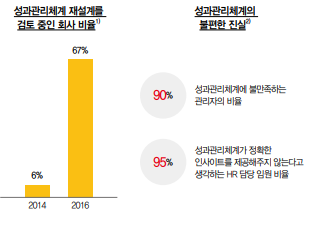
This article looks at what problems leading companies recognized in their performance management, what their major change points were, and what the key success factors of the change are.
When you run performance management projects, you hear similar complaints from most stakeholders. "Management has become management for management's sake. It was created to raise performance, but it actually eats away at performance." In particular, organizations that run performance management strictly emphasize precise measurement of performance, and end up pouring a lot of energy into it. The goal-setting, mid-period check, evaluation, and feedback process itself also generates a substantial amount of additional work that does not directly contribute to improving performance. The paradox arises that the more you emphasize the importance of performance management, the more resources are consumed by the process itself.
[Case] Deloitte3)
While redesigning its performance management system, Deloitte investigated how many resources had been invested in the existing performance management procedure.
The investigation found that 65,000 employees were spending about 2 million hours a year on performance management-related document creation, meetings, and so on.
Traditional performance management applied relative evaluation. Relative evaluation, which lines employees up, inevitably strengthens internal competition and risks side effects. In particular, employee stress increases due to internal competition, and collaboration between employees is hindered. This poses a risk of lowering the company's productivity and innovation potential.
[Case] Microsoft4)
After Microsoft introduced the well-known relative evaluation system called "stack ranking" in 2006, its collaborative culture was damaged. Employees became absorbed in internal competition rather than competing with rapidly growing external rivals like Google, Apple, and Facebook. To avoid being disadvantaged in stack ranking, they even avoided working with outstanding employees.
Microsoft eventually scrapped stack ranking in 2013. One outlet described stack ranking as the main cause of "Microsoft's lost decade."
As the Fourth Industrial Revolution begins in earnest, the speed of business environment change has accelerated dramatically. Annual goal setting and semi-annual mid-checks have become inadequate for responding to changes in the business environment.
But a more important change is not external environmental change but the change in the internal employee composition. The share of Millennial-generation5) employees is growing. The Millennial generation has many characteristics, but the work-related characteristics can be largely summarized in three points.6)
First, they value the meaning and value of work more than previous generations. Millennials, when they recognize the meaning and value of work and feel interest, tend strongly to engage with and devote themselves to that work.
Second, they value their own growth through work. Millennials, having experienced low growth from a young age, do not expect lifelong employment or a long run within an organization. Conversely, they want to build their capabilities and grow so that they can immediately switch jobs if a problem arises with their current workplace or a good external offer comes along.
Third, they want horizontal communication and frequent communication. Millennials, accustomed to social media, have no trouble communicating constantly. And they want to communicate immediately and frequently regardless of the other person's position.
Considering these characteristics, to raise the performance of Millennial-generation employees, you need to continuously have them resonate with the meaning and value of the work, support them so they can grow through the work, and ensure that the related communication happens immediately.
Companies that recognize the side effects of relative evaluation are changing the philosophy of performance management in two main directions. First, applying relative evaluation flexibly. Second, completely switching to absolute evaluation. In the past, the per-grade distribution rates of relative evaluation were strictly applied in many cases. Applying relative evaluation flexibly means setting the per-grade distribution rates as ranges rather than fixed values, or limiting only the very top grade's rate.
This is grounded in the logic that strictly applying per-grade distribution rates tends not to match the actual performance distribution of employees and only fuels unnecessary internal competition. This kind of approach is mainly used by companies that recognize the side effects of relative evaluation but want to maintain a certain level of internal competition.
The complete switch to absolute evaluation is grounded in more radical logic. Past relative evaluation was a method of distributing grades on the assumption that the distribution of employee performance levels would form a normal distribution curve, a bell curve. So if 10% were given the highest grade, 10% would also be given the lowest grade. Recently, however, the argument has been raised that, in most job areas of business activity, employee performance follows an L-shaped power function distribution.7) Based on this logic, cases are emerging where performance grades are not assigned at all, or where most employees are given a normal grade while only a few outstanding performers are given the highest grade.
Most companies that have recently redesigned their performance management have shortened the goal-setting cycle. In particular, the faster the pace of change in the relevant industry, the shorter the evaluation cycle. There are many cases of switching from the past annual cycle to half-year, quarterly, or monthly evaluation cycles, and some run performance management with frequent feedback alone, without setting a separate evaluation cycle.
[Case] Naver8)
Naver, in keeping with the fast-changing nature of the IT industry, switched to a feedback-centered evaluation system focused on improving employees' learning ability and growth. Feedback consists of P-Review (Performance Review), related to work progress, and C-Review (Co-work Review), related to collaboration. They are conducted as frequent feedback without an evaluation cycle, and no evaluation grades are assigned either.
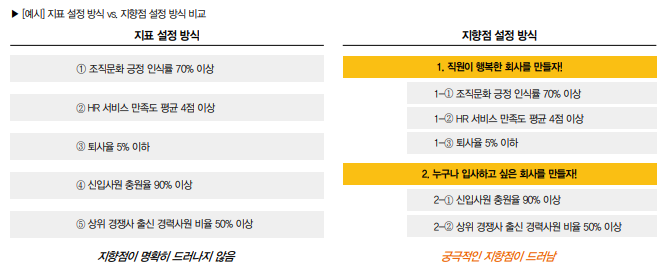
Past performance management emphasized setting and managing KPIs. The focus was on what to manage well. As a result, it carried the problem of "management for management's sake." When you manage some indicator, there is a risk of losing sight of why you are managing it and what the ultimate aim is. So it is changing toward a way that emphasizes the qualitative meaning of the goal more than the indicator setting itself. This lets employees frequently recall the ultimate aim and also helps with motivation.
Formal regular discussions are discussions where documents are prepared in advance and the discussion takes place at a set time. The time is set in advance and a defined-format document is created. Formal regular discussions can have the side effect of "performance management eating away at performance" by increasing the resources spent on the performance management activity itself. Also, because feedback is given only at specific times, it is hard to respond promptly when the environment changes rapidly. So to reduce the cost of running performance management and respond promptly, there are many cases of switching to informal frequent discussions — held without a defined format whenever the need arises.
[Case] Korean Group A
Group A had a problem awareness that performance management activities were being conducted as separate additional work, divorced from actual work. To minimize performance management activities becoming additional work, Group A combined its existing weekly work reports — held once a week — with performance management. Through this, all employees naturally received about 50 frequent feedback sessions per year.
Past performance management focused on producing evaluation grades through relative comparison, and so naturally focused on measuring performance — confirming "how well someone did." But if you think about the fundamental purpose of performance management — "how to raise performance" — the focus should be not on how well someone did but on "how to do better going forward." So the focus shifts from measuring past performance to feedback aimed at raising future performance. From this angle, the term "performance management" is sometimes replaced with "performance development."
And one more notable change. In the past, feedback was given from the perspective of strengthening strengths and supplementing weaknesses at the same time. But recently, the argument has been raised that, rather than giving feedback on strengths and weaknesses simultaneously, intensively managing strengths is more effective for raising performance.9)
In this context, there are also cases of performance management where employees praise each other's strengths on a web bulletin board or attach strength badges to each other.
For new performance management to work fully, employee perceptions of performance management and the organizational culture must change at the same time. Past performance management pressured employees and induced them to compete with each other. As a result, employees naturally felt uncomfortable with performance management and avoided performance management communication. But new performance management induces them not to compete internally but to praise each other's strengths and give mutual feedback to raise performance. So performance management communication must be conducted with a more open posture, and the organizational culture must also support employees in supporting and encouraging each other's growth.
It is no exaggeration to say that new performance management is all about feedback for performance improvement. So you must strengthen the feedback capability of managers — the main subjects of feedback. It is also necessary to include feedback capability as a verification element for manager appointments. When introducing a 360-degree feedback method, you must support not only managers but all employees in building feedback capability.
New performance management requires employees to be able to look at each other's work progress in real time and give immediate feedback. It must also be able to accumulate and manage the comments and feedback related to the work over time. The problem is that conducting these many processes on a document basis can lead to even more energy being consumed by the process itself than in the past. So building HR IT infrastructure that fits the new performance management system must also be conducted at the same time. GE, which recently improved its performance management system, also built its own solution called PD@GE.
[Case] GE10)
GE was famous for the strict relative evaluation system that fired the bottom 10% of low performers. During this period, GE's corporate value grew an astonishing 40 times, and this system became the benchmark for many companies. But judging that the 10% rule did not fit the digital age, GE recently scrapped the 10% rule and introduced PD@GE (Performance Development at GE), centered on continuous mutual feedback. On the effects after introduction, a GE HR executive said, "Once employees were given the opportunity to give each other feedback, the top-down culture disappeared and the atmosphere shifted to something horizontal and free. Collaboration naturally increased, and we were able to surface fresh ideas."
I have looked at what problem awareness leading companies had with their existing performance management, how they improved the problem, and what the requirements for successful improvement are. Many leading companies have tried various experiments to solve the problem. Each company adopted a different form of system depending on its strategy and environment. But while the forms vary, there is a consistent direction. They avoid unnecessary internal competition, minimize cumbersome and unnecessary procedures, and focus on improving future performance rather than measuring past performance. I hope this becomes a milestone for companies considering redesigning their performance management systems.
1) 2/3 of Companies Are Reengineering Performance Management, Institute for Corporate Productivity (2016)
2) Is It Time to Put the Performance Review on a PIP?, SHRM (2015)
3) Reinventing Performance Management, Harvard Business Review (2015.04)
4) Microsoft's Lost Decade, Vanity Fair, (2012.08)
5) Millennial Generation: Born after the 1980s, the generation that grew up experiencing computers, the internet, and mobile phones from a young age
6) Reconstructed based on "Motivation Methods Needed for the Millennial Generation," LGERI (2016.09)
7) Google Work Rules, Laszlo Bock (2015)
8) "NHN's Drastic HR System Overhaul.. The Venture Spirit?", Electronic Times (2012.12.04)
9) The End of the Performance Review, Tim Baker (2013)
10) "The 10% firing rule... GE, the first to introduce it, has already abolished it," JoongAng Ilbo (2016.05.13)