

Related Solution
HCG HR Solutions
hunel · JaDE · talenx — we propose the right HR solution for your organization.

Solve Complex HR Challenges with HCG
Talk to our experts
Insights
"At my company, every day is overtime. Hobbies are out of the question." "At my company, no matter how wrong the senior manager's opinion seems, I can't disagree. I'm the lower-status one — what choice do I have but to follow?" These are just a few examples, but they are the kinds of things we frequently hear in conversations with friends or workplace colleagues. Let's think about these statements not just as gossip but from the perspective of corporate culture. We can reasonably infer that the first company is one with insufficient regard for employees' lives and that excessively emphasizes performance-ism, and that the second is one where one-way communication and imperial leadership have become entrenched.
The way of working that happens daily inside a company and is implicitly agreed upon by employees — that is, "company style" itself — can in a broad sense be defined as corporate culture. So why is corporate culture important?
The importance of corporate culture stands out in three areas.
First, corporate culture as a means of organizational integration. In M&A processes in particular, cultural fit between companies is evaluated as a key factor that determines success and failure. Second, corporate culture as a driver of performance creation. According to a Harvard Business Review survey, 71% of executives worldwide answered that employee engagement is an important element in organizational success — indirectly emphasizing the importance of corporate culture, which influences employee engagement.
Third, corporate culture as a standard for selection and development. As experiences accumulate that talent with high cultural fit has high potential growth, leading Korean companies are using this as a major verification point in hiring interviews and continuously running core values training in which corporate culture is embedded.
As the importance and influence of corporate culture is increasingly confirmed both theoretically and empirically, attempts to actively manage corporate culture have been growing recently.
The diagnosis of corporate culture, as a precondition for this, has also become a hot topic in the HR area. It is time for meaningful reflection on reasonable methodologies for diagnosing corporate culture. So how should a company's culture be reasonably diagnosed?
Edgar H. Schein, a guru in organizational culture research, in his book concluded that culture is hard to measure through surveys and proposed Focus Group Interviews (FGI) to identify the deeper elements of culture — values and underlying assumptions. But FGI is hard to use as a general methodology because some employees cannot represent the whole and because it is hard to secure consistency of interpretation.
From that angle, the employee survey method — currently the most widely used methodology for diagnosing corporate culture — still holds persuasive power and remains valid. Diagnosing corporate culture does not have one specifically defined method; many methodologies have been developed and used to analyze the culture of various companies. Each diagnostic methodology has its own distinctive features, but broadly speaking, they can be divided into two — the Type Model and the Profile Model.
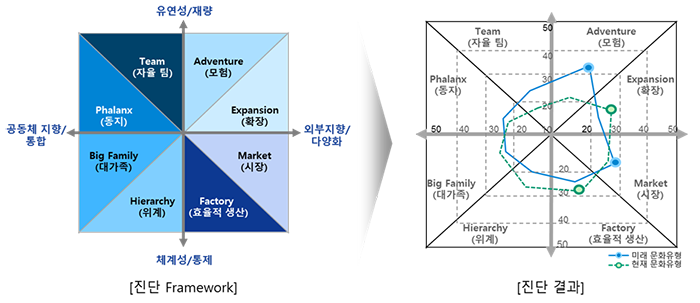
First, the Type Model is a diagnostic method that classifies a company's culture into a few characteristic types and uses a survey to find out which type the company is.
Representative methodologies in this model include OCAI (Organizational Culture Assessment Index), OCI (Organizational Culture Inventory), and DOCS (Denison Organizational Culture Survey). The Type Model mostly uses Quinn's Competing Values Framework as the theoretical basis for typifying corporate culture, and is most distinctive for its value-neutral character.
For example, even if a company's type is diagnosed as control-centered, that is not lower in value than an autonomy-centered culture. For factory-centered manufacturing, where accuracy and consistency of work are important, the fit may actually be higher.
The biggest advantage of this model is that the diagnostic results are highly intuitive. Just from the title of each type, we can immediately understand or infer the characteristics of each. Because of this advantage, the Type Model is mainly used to identify the gap between current culture and ideal culture, or to compare cultural types with other organizations.
The disadvantage, on the other hand, is that the practical usability of the diagnostic results is low.
Because of its value-neutral character, it shows clear limits when it comes to diagnosing levels in specific issue areas or deriving concrete improvement tasks from the diagnosis.
This is why methodologies in the Type Model always come with the tag "So what?"
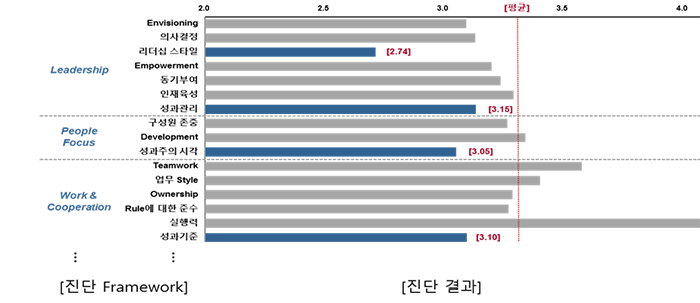
Second, the Profile Model is a diagnostic method that defines the elements (cultural factors) that make up a corporate culture and then quantifies and measures their levels.
Representative methodologies in this model include OHI (Organizational Health Index), OCQ (Organizational Culture Questionnaire), and OEI (Organizational Effectiveness Inventory). Each cultural element is scored and ranked relative to a maximum score, so unlike the Type Model, this carries a value-oriented character. The biggest advantage of this model is that the concrete usability of the diagnostic results is very high.
Because the current level of each cultural element appears as a score, it can be practically used for identifying issue areas through relative analysis against norm data, deriving improvement tasks, and managing change through monitoring of historical averages.
For example, if a company hypothesizes that conflict between employees has become more frequent and the organizational atmosphere has slumped after an M&A, it can verify the issue through diagnosing factors like Conflict or Communication. The disadvantage, on the other hand, is that meaningful results can only be derived if the general errors that arise in numerical surveys are well controlled. For example, if the diagnostic result of a specific element is linked to a KPI or has a direct connection to employee advantage or disadvantage, scores can become excessively lenient or excessively harsh.
I have looked at the two models for diagnosing corporate culture. Because the strengths and weaknesses of each are clear, you should use the model that fits the purpose of the diagnosis. Using both at the same time is also worth considering. But you would first need to solve the difficult question of how to maintain the logical link between each result and how to interpret a mismatch when one occurs.
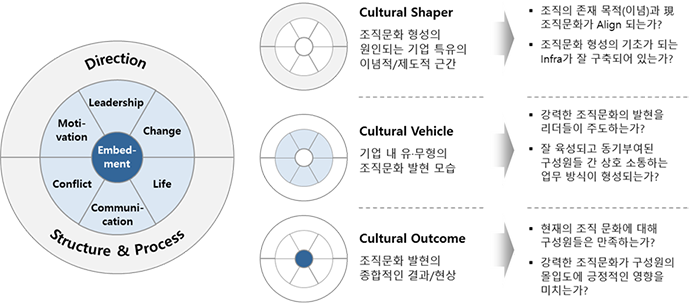
There are countless methodologies for diagnosing corporate culture, but to be more effective and differentiated, the diagnosis must have the following two elements.
First, it must be able to diagnose corporate culture from a comprehensive and inclusive perspective. The cause-and-effect relationships of cultural issues at a company are very complexly intertwined, so it is difficult to identify the root cause through simple symptom diagnosis alone in most cases.
For example, employees' attitude of "do nothing, get into no trouble" is often caused by performance-ism or the lack of an embedded culture of encouraging innovation, but in some cases, leadership that avoids responsibility may be identified as the main cause. So corporate culture diagnosis must comprehensively grasp the cultural phenomenon (Cultural Vehicle) itself, the structural elements that influence it (Cultural Shaper), and the level of organizational culture embodiment (Cultural Outcome) from a causal perspective.
Second, the diagnostic elements (cultural factors) and survey questions (questionnaire) must be able to directly reflect the characteristics of Korean corporate culture.
Depending on the political and social environment and the history of economic development, there are clear differences in the corporate cultural issues each country faces.
For example, conflict between the older generation that worked through Korea's rapid economic development and the current generation, and childcare issues caused by the increase in working women and a system that does not support them, are areas of corporate culture in Korea that should be diagnosed in depth as obstacles.
But existing diagnostic methodologies, in their emphasis on global universality, often end up measuring things diluted into extremely generalized diagnostic elements and survey questions. If the ultimate purpose of diagnosing corporate culture is to identify and resolve issues that actually arise, then we should be asking more direct questions grounded in the issues Korean companies face.
Even though the importance of corporate culture grows day by day, some companies and executives still tend to treat it as just one of the hygiene factors
and overlook its meaning. But a well-built corporate culture can raise actual corporate value through internally motivating employees and externally improving the company's image. From that standpoint, it should now be seen as one of the company's core competencies.
If you want to build a strong corporate culture, you must first identify the current culture through accurate diagnosis. With reference to the diagnostic methodologies introduced above, you should start now — not as a belated diagnosis after corporate culture has already broken down, but as a diagnosis activity at the level of forming a corporate culture grounded in clear direction.