

Related Solution
HCG HR Solutions
hunel · JaDE · talenx — we propose the right HR solution for your organization.

Solve Complex HR Challenges with HCG
Talk to our experts
Insights
A Korean portal site survey of about 1,800 office workers asking whether they were still at their first job found that 87.6% of all respondents had left their first job, and only 12.4% were still at it. Now that the term "lifelong employer" has disappeared, modern workers' work patterns have also undergone significant change.
The number of people working without belonging to any one place is rising. They are called "gig workers," and to understand who a gig worker is, we first need to understand the word "gig."
In 1920s American jazz venues, performers were brought in on the spot under short-term contracts to perform — and these performances were called "gigs."
Borrowing this term, the economic phenomenon in which companies — in a fast-changing era like the Fourth Industrial Revolution — sign temporary contracts and hand work over to people as needed has come to be called the "gig economy." Originally, "gig" was used mainly to refer to non-regular workers like developers and designers in IT, but its meaning has now expanded across all industries.
The gig economy is also related to the on-demand economy — an economic system that delivers services and goods to customers via online or mobile networks based on customer requests. As the on-demand economy spreads, demand for the labor needed to deliver services to customers grows, and the view is that the work pattern best suited to this is the gig worker.
A gig worker is someone who provides ultra-short-term labor — signing short-term contracts or taking on one-off jobs as needed by an employer.
What sets them apart from existing short-term work patterns is that the brokering of labor takes place on a digital platform. Examples include solo contractors like ride-sharing drivers and delivery riders that emerged with the spread of the digital-platform-based sharing economy. Starting with cars and accommodations, the work areas have expanded to simple-labor services like delivery and cleaning, and most recently are evolving into services that involve specialized professionals like lawyers and consultants.
These workers operate from smartphone applications, free of any specific organization. As long as they meet certain qualifications, they work freely at the times they want and are paid per project. They can adjust their working hours to their own schedule, live without commutes, and enjoy high autonomy because they are not tied to a company.
Because they earn what they work, the number of modern workers dreaming of becoming gig workers is steadily growing.
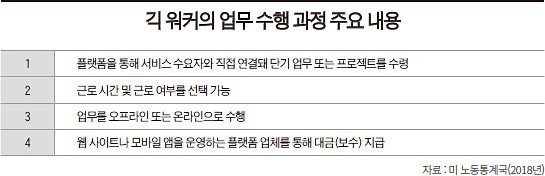
Korea's Employment Information Service estimated the number of domestic gig workers at 469,000–538,000, or 1.7–2.0% of all employed people (2019).
Worldwide, the number of gig workers cannot be precisely measured because of variation by country and survey method, but they are estimated to make up about 20–30% of the economically active population in the United States and Europe. Global consulting firm McKinsey has projected that the gig economy created by gig workers will generate added value of $2.7 trillion — about 2% of global GDP — by 2025.
In Korea as well, on-demand services across various industries have been emerging. From food ordering services and renting out a parking space in front of one's house, to car maintenance, car washing, laundry, and household services — all are being run through the gig economy. Korea's Employment Information Service has been compiling "domestic digital platform worker" statistics since 2018, and according to its findings, the share of workers by service area is 24% in proxy driving, 23% in food delivery, 23% in courier services, and 30% in taxi driving. Korea's gig economy is spreading mainly around side gigs and delivery work.
For example, Kakao has built a system that hires drivers for proxy driving, and Baedal Minjok runs "Baemin Connect," a short-distance delivery service to handle the surging demand. Coupang runs "Coupang Flex," a delivery partner program for ordinary people, which is reportedly popular among younger people looking to earn supplementary income outside their working hours.
The recently emerging Millennial generation, however, shows a somewhat different pattern. Millennials tend not to want to grind through dull work but rather to pursue what they want, voluntarily, with enjoyment and freedom. As a result, gig economy platforms are becoming more active.
Among gig economy platforms, the one with the most users worldwide is Upwork. Upwork is a platform where freelancers register their abilities and skills, and companies can hire the talent they need. It has 12 million freelancers registered, with more than 3,500 types of skills listed.
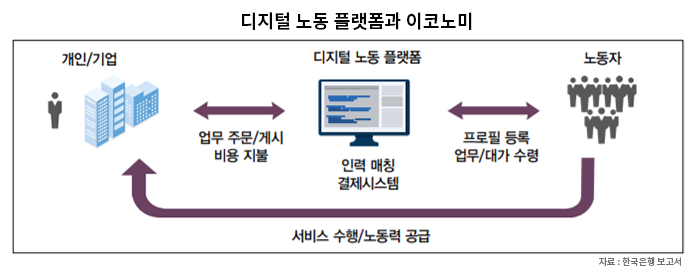
A similar Korean platform is Kmong. The services registered on Kmong reach about 170,000 — including content creation, marketing, interpretation and translation, business consulting, and lessons. Total transactions number about 1.05 million, and the number of active freelancers is around 20,000. By 2019, the cumulative transaction amount had exceeded 70 billion won, and 630,000 people use the platform. It connects the demand for finding skilled experts on short notice with freelancers who have specialized skills, and is distinctive in that more specialized-skill transactions take place there than on a typical service.
Use of gig economy platforms is expected to grow further as an alternative in a difficult economic environment with unemployment problems.
However, because labor laws and systems treat platform workers as individual business operators rather than employees, there are also concerns.
Gig workers overseas, and social arrangements for stability of work — overseas as well, the gig economy initially started around simple-labor services like cars, accommodations, delivery, and cleaning, but has recently been evolving into services involving specialized professionals like lawyers and consultants.
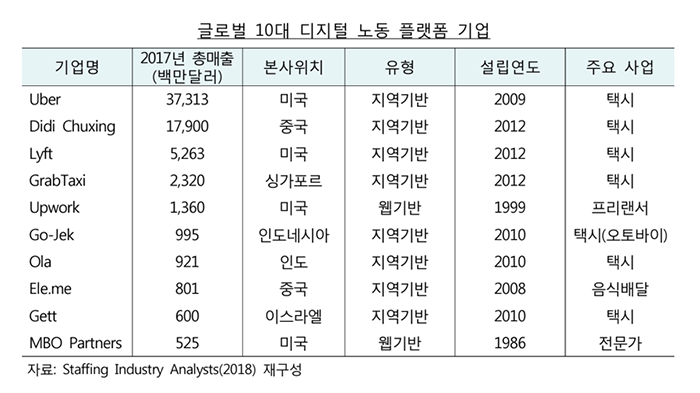
That said, the majority (more than 70%) of total revenue across global platforms still comes from the transportation sector — Uber, Didi Chuxing, Lyft, and others.
Uber in particular recorded high growth, with net revenue rising about 100-fold over the past five years.
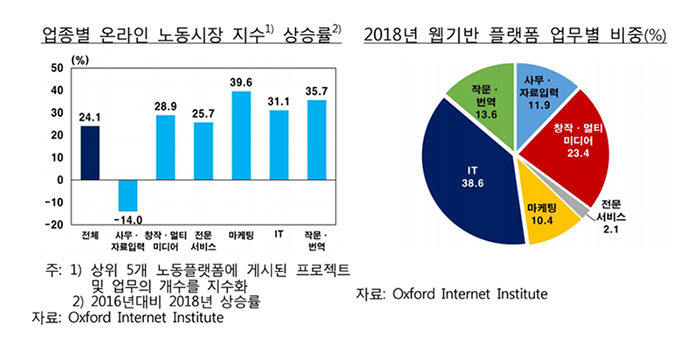
Web-based platforms not tied to a specific geographic area — unlike transportation or delivery — are growing around high-tech, high-skill specialized services. Looking at the Online Labor Index (OLI), calculated from the number of projects and tasks posted on web-based labor platforms, IT and creative/multimedia work makes up more than half of the total, and the share of marketing and writing/translation work has been rising significantly over the past two years. That said, only two of the top 10 global digital labor platform companies are web-based, and the per-company revenues are still small in scale.
Recently, large companies are also directly using these gig economy employment forms or partnering with startups to provide related services.
Amazon launched "Amazon Flex" in 2015, which uses ordinary people who own personal vehicles as delivery couriers to reduce costs while delivering its "Prime Now" same-day service. Drivers participating in Amazon Flex are paid $18–$25 per hour and can freely work as much as they want within a 12-hour daily cap.
U.S. pharmacy chain Walgreens partners with TaskRabbit to provide medication delivery services, and Costco partners with Instacart to deliver the groceries customers want.
However, opinion around the world is sharply split for and against gig economy services. The view of the gig economy is divided between "innovation" and "taking away people's livelihoods." The "unprecedented opportunities" the gig economy will create can be viewed positively, but there is also concern that, rather than creating jobs, it harms job stability by using people only when needed.
The UK has accordingly begun pursuing ways for gig workers to receive appropriate social protection. It has implemented legislation that exempts up to €2,500 of sharing-economy income from taxation while strengthening the rights of gig economy workers.
The United States has changed administrative interpretation so that the Fair Labor Standards Act can apply to people who provide labor under independent contracts and would otherwise not be classified as workers. Japan is also working on legislation to embrace gig workers — expanding tax benefits, specifying minimum wage levels, and preventing oral-only contracts. Germany, which published the "Work 4.0" report, is searching for labor reform measures in response to digitalization.
In Korea, the number of platform workers is also steadily increasing, but most platform workers are not enrolled in the four major social insurance programs — national pension, health insurance, employment insurance, and industrial accident insurance. They also do not enjoy retirement benefits. The stability of gig workers' lives is low. Government legal and institutional support is needed here. As advanced countries overseas have done, options worth considering include lowering tax rates on gig economy income or imposing welfare contributions related to gig workers on platform companies. The government and related institutions could also collect legal taxes from one-person entrepreneurs and then protect and regulate them within a legal framework. For example, legalize earning compensation through ride-sharing in personal vehicles, impose taxes on the resulting income, and protect their working environment.
Companies should prepare ways to make good use of capable gig workers.
First, they need to identify the skills the organization is missing so that fitting, skilled gig workers can be hired in a timely way. Companies also need to build systems that integrate gig workers into the organization and let them perform work effectively. When regular employees work alongside freelancers, they often complain that they ended up redoing all the work themselves — because the freelancer's understanding of the organization is low and work communication does not flow smoothly. Companies need to clearly present the role gig workers should play and build a structure that lets them collaborate well with the company's regular employees. Because what drives gig workers is fundamentally different from what drives regular workers, it is necessary to reflect the working hours, environment, and work autonomy they want.
Gig workers themselves also need to prepare.
One of a gig worker's concerns is irregular income. An ordinary office worker can receive a stable salary by simply meeting the assigned working hours, but a gig worker has to manage their own time well to generate stable income. They have to plan their own schedule and manage their time efficiently. Because gig workers supply labor individually, their wage bargaining power may be limited compared with the organized workers of traditional industries. Because there is no guaranteed reward and dismissal can become free in the end, in the gig economy era managing one's own work capability is also important.
One of Korea's major challenges in recent years is job creation. Activating one-person self-employment can lead to job creation effects. Because the spread of the gig economy in Korea is expected to accelerate on top of world-class internet networks and the mobile commerce market, we need to actively prepare for it. Through appropriate development plans pursued at the government, corporate, and individual levels, we can hope for the stable growth of gig workers.