
Related Solution
HCG HR Solutions
hunel · JaDE · talenx — we propose the right HR solution for your organization.

Solve Complex HR Challenges with HCG
Talk to our experts
Insights
"The coronavirus has spread. The company has ordered work from home. At first I was glad there was no supervisor watching me, but now that I have to report my work output every day, the burden is real. At times like this, I miss my supervisor's advice and my colleagues' help. There are ominous rumors that the company, whose results have worsened, is thinking about restructuring this time around. Even when I go back, I'll probably have to do more work than I'm doing now."
The global disaster that began with an infectious disease has shaken our lives and our corporate environments to the core in just a few months. The problem is that even after the current situation calms down, going back to the past will be difficult. The competitiveness of existing industries themselves, the global value chain — almost the entire business environment — has been newly reshaped. In this era when every expert is predicting a Post-Corona, New Normal, how should HR respond?
The core keyword for HR in the Post-Corona era is expected to be "Untact" (contactless). The term originally came from a marketing trend definition for the explosive growth of contactless product/service delivery — online/mobile/VR shopping, kiosks — but through the COVID episode, it has become a ground rule that runs through almost every social, economic, and cultural domain.
In HR as well, we expect the application area to expand around work from home (WFH), which separates the very space where physical contact is possible. According to a recent survey by market research firm Gartner, about 88% of global companies asked their employees to work from home during the COVID period. In a New Normal era where the past HR — in which face-to-face was a virtue — is no longer valid, this is a good moment to look at what HR needs to prepare for.
Untact HR does not mean complete independence — or isolation — at the individual level when it comes to performing work. We are still interacting within the economic community of "the company," and the mechanism by which we create performance through that interaction remains valid. So what is most needed in the era of Untact HR is, paradoxically, thinking about "connection," not "separation."
This kind of connection requires a primarily technical approach more than a policy-level one. In a hyper-connected society where messengers and social media are part of daily life, technology platforms guiding culture and individual behavior is already a common phenomenon. In the HR field in particular, the demand for diagnosing "contact" (employee-connecting) IT infrastructure and building new systems is expected to grow explosively over the next several years. The recent cases of many companies that ran into security issues and could not build a smooth work environment outside the company while implementing work from home raise a big question about whether our companies will be able to respond properly to the coming Untact era.
Alongside resolving internal infrastructure issues, the discussion of introducing external systems that can be applied immediately is also very active. The video conferencing application Zoom emerged as the most attention-grabbing company in the Post-Corona era, with explosive growth that took its global users beyond 300 million as of April. Many services that had previously been introduced as remote work tools are also being reevaluated. Slack, the representative communication tool, and the collaborative work tools Google G Suite and Microsoft Teams are drawing far more attention as effective systems for work from home than they did in the past.
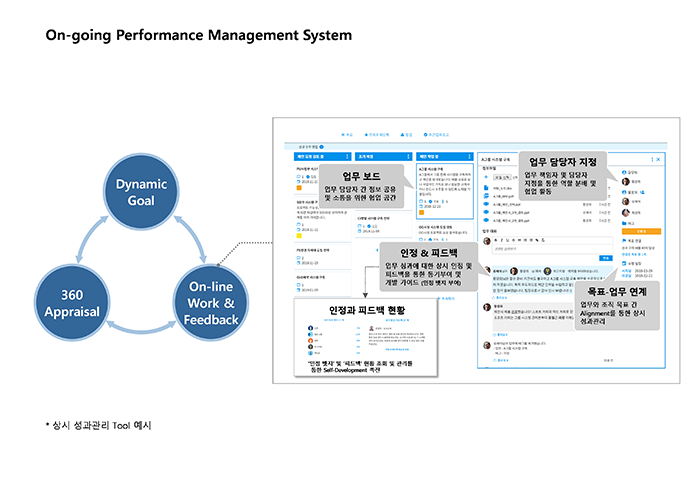
In the HR field, the spotlight is on systems that go a step further to also cover the company's performance management area (Figure 1). The remote work support tools introduced above are effective in providing services specialized for communication or collaboration, but they have clear limits when it comes to connecting that work to the performance of the company as a whole. Especially as we have been through this COVID episode — which was impossible to predict in advance — there is growing consensus on the validity of more flexible goal management, online-based continuous coaching and feedback, and 360-degree evaluation in environments where face-to-face observation has become difficult. HR practitioners need to think deeply about the system foundation needed to create company performance in an environment where Untact has become normal — separately from the systems needed for the immediate remote work environment like work from home.
(Figure 1)
Alongside building system-level infrastructure, redefining how work is done — fitted to the company's character — is needed. If today's work-from-home arrangements have been a primarily temporary, passive response to block COVID infection paths, then it is time to think fundamentally — from a long-term standpoint — about how we want our employees to work in a business environment where Untact has become the New Normal.
For example, a fresh job analysis is a good approach. Identifying jobs that should be reduced or strengthened in light of COVID can help with strategic redeployment of employees. In particular, it is important to use job analysis to distinguish jobs that are well suited to remote work from those that are not. Many Korean companies recently experienced failures by applying remote work indiscriminately, without preparation. There will of course be variation by company, but in general, jobs in management support, IT (which has low face-to-face needs), and content creators (where individual creativity matters more than collaboration) are likely to be more suited to remote work.
Alongside job analysis, I recommend trying work process analysis as well. Through process analysis, the unnecessary travel, simple reporting, or team-building regular meetings that had been done out of habit can be reduced or replaced with alternatives like video conferencing. On the recruiting side, AI interviews and big data analysis using past hiring outcomes can dramatically reduce the scope of in-person interviews.
Once the broad direction of how work will be done is set, HR should not spare effort in spreading and internalizing it across the organization. The change in how work is done — centered on Untact — is a transformation no one has experienced before. It is therefore not a process of partially improving what we have today; HR should guide employees with the mindset of building something completely new, and lead the way with best practices.
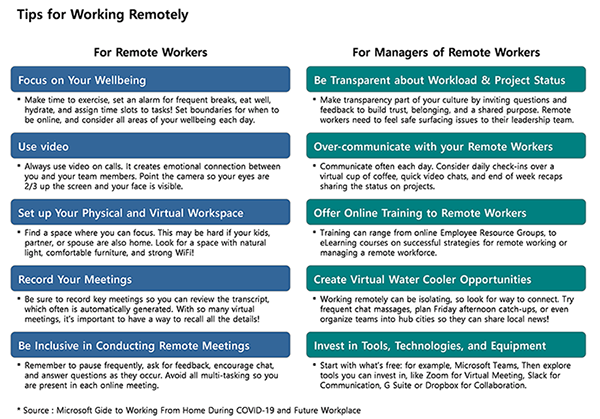
Microsoft's recent example (Figure 2) of providing tailored tips to remote workers and managers — guiding their concrete behaviors — is worth referencing in this context.
(Figure 2)
It may sound trite, but a crisis is an opportunity. The reshaping of the global industrial landscape in the Post-Corona era will mean the fall of those who fail to adapt and a higher level of competitiveness for those who survive. In the New Normal business environment captured by Untact, HR should focus first on building the system infrastructure that connects people to people. At the same time, it should help build a new mechanism for creating company performance through a fundamental shift in how work is done.
This was true during the IMF crisis and the financial crisis as well. The moment the management paradigm changes, HR has plenty of work to do.