

Related Solution
HCG HR Solutions
hunel · JaDE · talenx — we propose the right HR solution for your organization.

Solve Complex HR Challenges with HCG
Talk to our experts
Insights
The Korean word for "workplace" (직장) literally contains the meaning of "a place where labor is performed." In companies, gathering at a fixed location to do work has been such a natural scene that the very phrases for going to work and leaving work assume the equation work = workplace.
From 2021 onward, we can probably drop the physical-location meaning from this notion of "workplace." Even before that, smart-work centers and similar setups had been chipping away at the location constraint of the workplace, and communication technology that lets us handle every kind of work remotely has been advancing at remarkable speed.
In fact, a 2019 survey found that the share of employees who had worked remotely at least once over the past five years had risen by about 44%, and if we extend the comparison window to ten years, the share rose to as high as 91%. Moreover, 69% of the surveyed companies said they had at least one team operating fully remote. And many more teams were operating in a hybrid mode that mixes remote and in-office work. 1
What poured fuel on the trend was the COVID-19 pandemic. To prevent infection, working from home moved beyond being recommended into being effectively required. The conversation around "where to work" turned 180 degrees — from how to gather many people efficiently to how to disperse them more efficiently.
Out of this background came remote work — including work from home. If remote work is a day-to-day classification of where the work happens on any given day, then hybrid work, a term that has emerged more recently, refers to a longer-period work pattern: across a week or more, working remotely for a certain number of days and at the office for the rest.
When this unfamiliar term "hybrid work" first appeared, everyone thought it would be a temporary improvisation, lasting only as long as it took to suppress the spread of COVID-19. But the spread of hybrid work now looks like an unavoidable wave of change.
The evidence is in the survey shown in <Figure 1>: before COVID-19, only 30% of employees said they would work in a hybrid mode. After COVID-19, 52% said they would continue with hybrid work. The pattern of these answers suggests that the spread of hybrid work is by no means unrelated to social and organizational-cultural change. Setting aside infection control, why has hybrid work become so prominent?
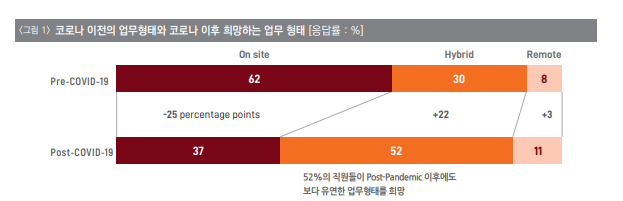
Reimagine Work, "Employee Survey" (December 2020 – January 2021, survey of 5,043 full-time employees at companies or government agencies)
As the trend of remote workers and office workers being mixed together — partly by choice and partly by necessity — spread, companies began to think about how to ride the wave while still maintaining productivity.
When people first talked about the benefits of hybrid work, many framed it in organizational-cultural terms.
The hypothesis was that being freed from the unnecessary tension, pressure, hierarchy, and workplace etiquette of "office life" gives employees more job satisfaction.
This framing — letting people use remote work freely — was tied to the changed lifestyles of the MZ generation and the "work-life balance" zeitgeist. Many executives and senior managers approached it with a half-charitable, half-critical attitude — partly seeing it as a benefit they were granting to younger employees, partly clucking their tongues at "young people these days" — and they often went into it with the mindset of "Yes, we'll set up the program because we have to, but we have no intention of giving up organizational discipline."
But seeing the spread of hybrid work simply as "a gift from companies to indulge the willful, self-centered demands of the younger generation" misses what is actually going on for younger employees. To understand it, we need to look beyond surface-level agendas like the advance of technology and the spread of disease, and consider cultural factors. Two organizational-cultural keywords help explain it: "childcare" and "collaboration."
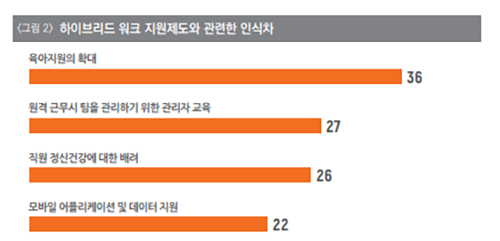
PwC US, "Remote Work Survey" (January 2021, survey of 133 U.S. executives and 1,200 U.S. office workers)
Indeed, the study in <Figure 2> surveyed the gap between the company's perception of "how much support" it was providing for various hybrid-work benefits and programs and the perception of the employees (the recipients) of those same items. The most overwhelming gap was for childcare support, followed by training for middle managers in remote environments and support for employee mental health.2
This result can be read in two ways: items at the top might be where employee needs are largest, or they might be where the company's support is most lacking. Either way, the temperature differences in <Figure 2> tell us which support items employees view as most "urgent" in the context of expanding hybrid work.
At first glance, it can seem strange that "childcare" — something not even directly work-related — has come to occupy such a large share. But as dual-income couples have become standard in households where childcare is the primary responsibility, and as multi-generational households (three or more generations) continue to decline, today's young couples increasingly find themselves in a situation where both partners must juggle work and childcare. In that situation, most younger employees treat the option of hybrid work not as a benefit or a mental-health perk but as a strategic tool for childcare. And in countries where many school-age and pre-school children stayed home after COVID-19, this has become an even more essential item.
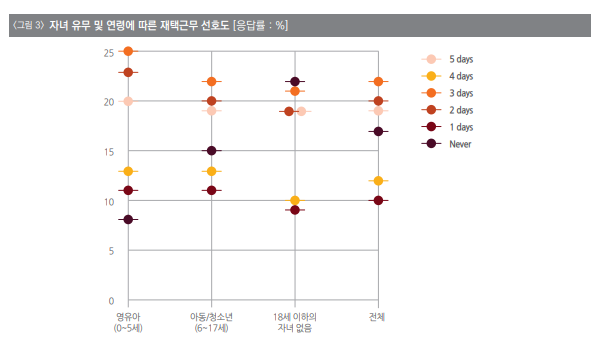
Reimagine Work, "Employee Survey" (December 2020 – January 2021, survey of 5,043 full-time employees at companies or government agencies)
According to the study in <Figure 3>3, just under 50% of employees with children aged 5 or younger wanted to work remotely two to three days a week, and 20% preferred working remotely five days a week. By contrast, more than 20% of those without children — or with children aged 18 or older — said they would not work remotely. The responses split sharply by the level of childcare pressure.
What is also interesting is the share of "I will not work remotely" responses: it ranks lowest among employees with children under 5, in the middle among parents of 6- to 17-year-olds, and highest among parents of children aged 18 or older. In other words, not every employee evaluates hybrid work positively across the board or wants to use it actively. The original hypothesis — that hybrid work is a charitable "benefit" — collapses at its own premise.
If hybrid work is not unconditionally welcomed by every employee, what is the reason?
The answer takes us back to where we started: looking again at the temperature differences between many employees' satisfaction with their company's remote-work support and the support actually being provided. If the overwhelming number-one item was childcare support, second and third were the adaptation of managers through training and support for employee mental health.
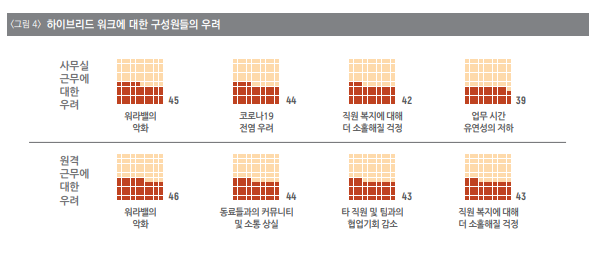
Reimagine Work, "Employee Survey" (January 2021, survey of 5,043 full-time employees at companies or government agencies)
In the survey above, the "concerns" question shown in <Figure 4> asked about four worries when working in the office and when working remotely. Two were common to both (work-life balance, neglected employee benefits), and the other two were different. For office work, the worries were COVID-19 infection and reduced flexibility. For remote work, the biggest worries were reduced communication with colleagues and reduced team and individual collaboration.
Putting it all together, the reluctance some employees feel toward hybrid work ultimately comes from the fundamental issues that remote work carries.
Losing the chance to communicate face to face with teammates, to have non-work everyday conversations, and to collaborate by offering small bits of help while sitting near each other — that is the foundation of the worries. The demand for training for managers can also be read as a self-defense mechanism — wanting to make sure that this loss of in-person opportunity does not "come back as a disadvantage" in evaluation and rewards.
In the end, the role HR has to play is to fundamentally resolve these employee anxieties.
First, younger employees who are juggling childcare are under more pressure than we might think, and an organizational-cultural approach to protecting them is needed. They have to be guaranteed more flexible working hours and arrangements, and because employees on hybrid work are particularly vulnerable to stricter attendance monitoring and unnecessary interference, thorough training is needed to dismantle the "uncomfortable gaze toward remote work" that lives in some managers' fixed mindsets. Hybrid work must not be perceived as a benefit or perk.
Next, the infrastructure needed for unconstrained hybrid work has to be in place. That infrastructure has to genuinely support remote work, and we should remember that simply assembling every "work" solution does not solve the problem. Real-time work sharing, conversation, video connection, reporting — all of it has to leave the in-person mode and move online. In some cases, encouraging online team-building meetings can also help accelerate the cultural transition.
Hybrid work is no longer something a company can hand out as a "favor" while taking credit for it. For younger employees, it has become a matter tied to the survival and continuity of their families. To find a proper answer to this for everyone, the place we work has to move from the office desk into the online cloud workspace. In that process, HR has to catch two rabbits at once: shifting the organizational culture and bringing the work itself online.
1) Remote Work statistics for 2019, FlexJobs
2) Remote Work Survey, PwC, January 2021.
3) Reimagine Work: Employee Survey, McKinsey & Co., April 2021.