

Related Solution
HCG HR Solutions
hunel · JaDE · talenx — we propose the right HR solution for your organization.

Solve Complex HR Challenges with HCG
Talk to our experts
Insights
The share of Millennials in the workplace continues to grow. Born between 1981 and 1996 — the commonly used reference point for Millennials — they number about 1.8 billion, roughly a quarter of the world's population. Forecasts suggest they will make up one-third of the global workforce by 2020. Generational conflict has surfaced with every new generation, but the Millennial response is clearly different from previous ones. Millennials confidently raise their voices about elements they consider unreasonable and, when needed, do not avoid leaving.
A Korea Employers Federation survey found that the rate of new hires leaving within one year jumped from 15.7% in 2010 to 27.7% in 2016 — a clear indicator of this. The problem is that it is the "hyper-performers" — the core talent — who are even more willing to choose to leave, more so than low performers. Sensing the crisis, organizations are attempting to change their culture and HR systems. The change is especially pronounced in the area of work and performance management. Many companies are introducing IT platforms for work and performance management that take Millennials' preferences into account: openness and sharing, real-time mutual communication, and the desire for recognition.
Let's look at what aspects of Millennial preferences should be considered for successful IT platform adoption, what performance management methods fit them, and what the requirements for an IT platform that supports them should be.
Time magazine once described Millennials with the phrase "ME ME ME GENERATION" — meaning that Millennials place "my" happiness above all else. The same applies to how they perform their work. Because doing work they consider meaningful is an important factor in their happiness, they first ask whether the work they are doing is meaningful work.
They have a strong desire for relationships and recognition. From a young age, they have grown comfortable with forming relationships with various people through social media, and they especially enjoy receiving recognition through likes, hearts, and retweets. They also find it very natural to communicate immediately, in real time, with anyone — whoever the other person is — through social media platforms. They also pursue "enjoyment" in their work. Some criticize Millennials for being unable to distinguish between work and play, but Millennials enjoy banter — and many of their best, most original ideas have come out of moments of fun like that.
Before performance management — setting and managing goals — what must come first is motivation. When I want to set goals and perform work, being able to first see what goals and direction the company has, what situation it is in, and how my work will contribute to that, helps with motivation. To enable this, the company needs to disclose information about goals and work as much as possible. It also needs to support Millennials in voicing their own opinions and sharing the process and outcomes of the work they are doing.
Information and decisions should not flow only top-down — everyone should be able to participate and contribute. In this process, mutual real-time feedback and recognition for performance should be possible. Especially if you can add an element of "enjoyment," all the better.
Real-time information sharing and mutual communication is absolutely impossible with paperwork. The performance management/evaluation systems used in the past were also accessed only when events like goal setting, mid-period checks, or evaluation occurred — almost no one logged in otherwise. In many cases, the system wasn't even left open outside those event seasons.
Because no one logs in, information is not updated, and because information is not updated, no one logs in — a vicious cycle.
There are also cases of using a separate work management system in addition to the performance management system. In this case, work and performance are managed separately, requiring duplicate work and not connecting well — which is inconvenient. From the Millennial perspective, work and performance are not separate, so why should they be managed separately, and why should the same task be done twice? It is hard to understand.
Integration of work and performance management | A performance management platform for Millennials must, above all, be grounded in work. And in this work process, performance must be manageable simultaneously.
Sharing the process and results of performing work is itself the starting point of performance management, and the goal of performance management is to help employees take one more step in growth and produce higher performance through communication and feedback. Millennials place importance on growing through their work themselves. Leaving their own work records and feedback on the platform,
and being able to judge how much they have grown in the process, will further raise Millennials' work engagement.
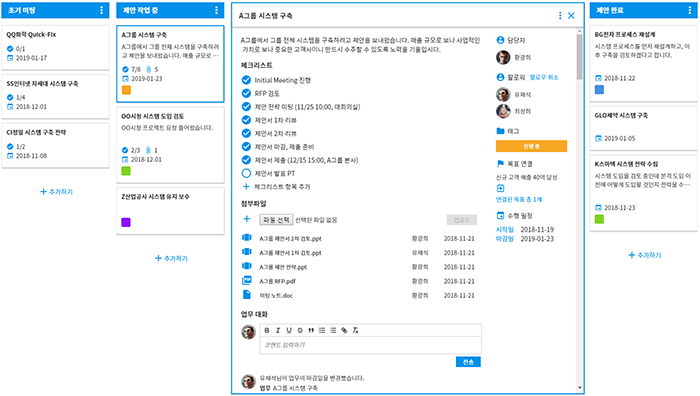
Similar to sticking sticky notes on a whiteboard, you can classify and manage work, and it is gaining popularity because goals can be linked and managed alongside it.
Transparent Disclosure of Work and Performance
Work and performance information should be disclosed in real time so that anyone can confirm progress and current status. This helps people understand the work context and accurately judge the points at which they should contribute. Engagement also rises when you can see at a glance how the results of your own work and performance contribute to the organization's performance. Beyond that, the disclosure of work and performance becomes a strong reference for the core performance management activities — feedback, recognition of performance, awareness of areas needing improvement, and connections to the broader HR system.
If you can confirm and discuss with your manager not only your own work but also how colleagues are working and what their results are, you can recognize your current level more objectively, and it also helps with setting future growth direction and expectation levels.
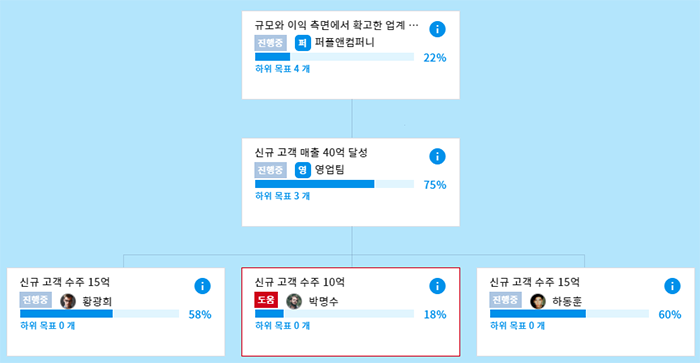
You can see in real time how the goals of the organization and its employees are aligned and connected, and what the current achievement level is.
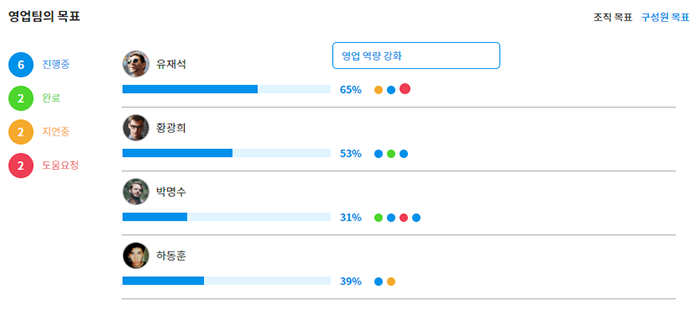
The goal achievement level of employees is shown as a graph, and the current status of each goal is distinguished by color.
Real-Time Multi-Source Feedback
Anyone should be able to communicate and give feedback in real time. Having to wait until a specific point in time to hear feedback about yourself is very awkward for Millennials — especially if it is negative feedback. Imagine a feedback meeting under the traditional one-year performance management system.
If a manager gives a Millennial negative feedback about work from several months ago — "You shouldn't have done it that way…" — the Millennial's reaction is likely to be,
"Why are you only telling me now? You should have told me right at the time…" Also, having only the manager give feedback is something Millennials are unaccustomed to.
Whether for products, cultural works, or specific people, Millennials are familiar with the crowdsourcing approach of leaving review opinions and making decisions based on others' review opinions — usually summarized as star ratings. The same applies in the work process. Most work is done through collaboration with colleagues, and in this process, not only managers but also colleagues can confirm each other's work process and performance.
Millennials are accustomed to giving each other feedback opinions, layering empathy and additional opinions on top, and creating more meaningful feedback together. In particular, mounting fun elements like "badges" or "hearts" so that feedback can be given easily and enjoyably — "funware" — will help drive Millennials' active participation.
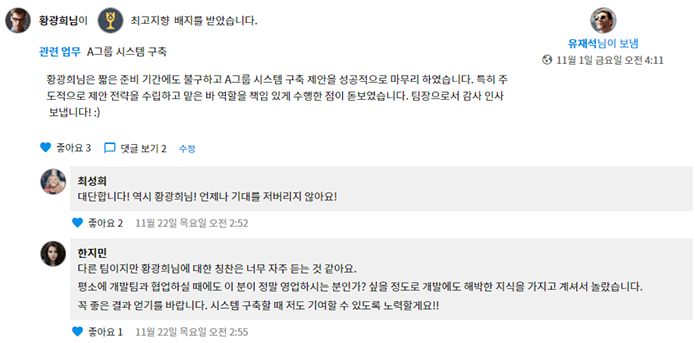
While giving feedback to a specific employee, you can grant a "badge." Other employees can express empathy through "likes," and add additional opinions through "comments."
Accumulating Data and Using Analytics
If employees interact and diligently leave feedback records but those records are only kept and not used, the meaning of the records becomes unclear, and it will be hard to expect active participation from employees afterward. The problem is that integrating work and performance management and conducting real-time multi-source feedback during the work-performance management process makes the dispersion and fragmentation of records very likely. The subject, timing, and target of the records keep changing.
To use feedback records meaningfully, dispersed data must be systematically accumulated. Accumulated data should not be just a simple list — it should be processed into meaningful information using data analytics. And if the analysis results are used in formal 1:1 meetings or reviews, Millennials will become even more engaged with mutual interaction and feedback. The recent performance management trend in particular recommends frequent 1:1 meetings between managers and employees, and the analysis of performance and feedback data based on a real-time platform will become material that makes the content of those frequent 1:1 meetings richer — raising both the effectiveness of the meetings and employee satisfaction.
From the perspective of considering Millennials' preferences and drawing out their potential to the maximum, I have explained the necessary functions and characteristics — integration of work and performance management, transparent disclosure of information, real-time mutual multi-source feedback, accumulation and analysis of feedback data. But the new platform's functions are not only useful for Millennials.
Under the traditional performance management system, the burden of performance management and evaluation on managers has been growing. Employees have continued to complain that "it is not based on facts" and "the manager doesn't put in effort," while managers have countered with the opposite — "I cannot observe everything one by one alone" and "If I do 1:1 feedback with all employees, I cannot get my own work done."
Neither side's complaint is unreasonable. It is a problem that inevitably arises in a system where all responsibility and authority are concentrated solely on the manager.
The new platform lets the closest observers leave immediate records, and lets multiple people add empathy and additional opinions on those records.
It organizes those records clearly through data analysis and lets you use them in 1:1 conversations.
Managers can know new facts they could not have observed themselves, can leave rich, vivid records without putting in much effort themselves, and can perform performance management work based on feedback data organized through analysis.
Technology advances have revolutionized how work is done. As computers and the internet developed, email and electronic approval replaced paper documents, and instant messengers soon reduced email and gradually took over the core role of communication. Now, as mobile devices and the cloud advance, digital workplaces or remote work that can replace in-person meetings and even collaboration are gradually going mainstream.
Also, Millennials — and the Gen Z that follows them — have grown up handling digital devices and forming and recognizing relationships in digital environments since childhood. They are called digital natives, and they are increasingly populating the workplace. Keeping pace with this, how will performance management change?
Just as we cannot do without email and messengers in the work environment, I am confident that new performance management approaches and platforms will soon become the mainstream. The change has already begun.