

Related Solution
HCG HR Solutions
hunel · JaDE · talenx — we propose the right HR solution for your organization.

Solve Complex HR Challenges with HCG
Talk to our experts
Insights
In the 1960s-set, true-story-based film Ford v Ferrari, Ford Vice President Leo Beebe is portrayed as someone who controls even the RPM of the Ford racing team's drivers. That era really was a time when those at the top thought and decided, and those below simply did as they were told.
The film, which depicts the racing rivalry between Ford and Ferrari, shows that the more management gets involved in the rapidly changing race environment, the worse the results become — and that letting the experts on the track, the drivers themselves, judge and respond to the situation produced the great achievement of three consecutive wins.
What about today? Can survival and growth still be achieved when those at the top give the orders and those below simply execute? There may be some variation by industry and function, but the rapid environmental changes of recent years have rendered annual goal-setting powerless and now demand quick goal revision and agile response. On top of that, the MZ generation that will lead the future demands long-term growth and recognition for their contributions rather than short-term rewards. As the era now puts a premium on agile goals, flexible thinking, proactive execution, communication and collaboration, recognition and encouragement, and continuous growth, agile performance management has been spreading among leading companies.
In other words, even without COVID, the changes in how we work — driven by rapid environmental, technological, and generational shifts — and the corresponding changes in performance management were already a predetermined change, demanded by the Zeitgeist of the era we live in. It is fair to say that COVID merely accelerated it.
For agile performance management, then, the question is only one of "timing" and "target" of implementation — it is best understood as an unavoidable change in response to broader environmental shifts.
Discussion of performance management tends to provoke negative emotions in employees. This stems from the fact that previous attempts to improve performance management produced little effect, or were even received by employees as making things worse. So adopting new performance management has to start with accurately understanding how the existing performance management is perceived internally.
If your company has already seen the end (the limit) of traditional performance management and fully understands agile performance management, this step is unnecessary.
But if you are looking into it because "leading companies like Google are doing it," I strongly recommend going through this step so that the change does not become yet another step backward.
Methods to find out how employees view the past evaluation system and what they expect from a new one include employee surveys,
employee interviews (especially of the MZ generation), and analysis of past evaluation results. Above all, it is essential to first have the CEO and senior leadership face directly how employees perceive the existing performance management. Then employees need to be given enough confidence — through real cases — that agile performance management is not some abstract notion but is already being adopted around us at speed.
One of the reasons companies hesitate to adopt agile performance management is the question, "It might be optimal for certain businesses or functions, but is it valid for others as well?"
If that's the case, examining the "essence" of the performance your company creates can clarify the strategy for adopting agile performance management.
For example, if Headquarters A creates short-term, individual, financial performance, then keeping the current absolute evaluation centered on individual annual financial performance is reasonable. On the other hand, if Headquarters B creates long-term, team-based, strategic performance, then introducing continuous performance management centered on the individual's contribution to team performance — to drive substantive performance improvement — is more desirable.
Thinking about target and perspective separately like this enables judgments such as: ① Is it reasonable to adopt agile performance management company-wide vs. only for specific organizations? ② Is it reasonable to adopt it all at once vs. in stages?
In the March issue, I described the "five characteristics of agile performance management," and in the April issue, I shared examples of agile performance management at various companies and noted the three most important things about it.
First, agile performance management was not newly "invented (Revolution)" to "replace" the existing traditional evaluation. It is an "evolution" that "complements" the weaknesses of the existing evaluation system.
Second, even leading companies that have already adopted agile performance management rarely possess all five characteristics.
Third, the most universal of agile performance management's characteristics are, in order: 1st, continuous review; 2nd, peer feedback; and 3rd, absolute or rating-free evaluation. Each one corresponds precisely to a limitation of the existing traditional evaluation system.
So companies should decide which characteristics to reflect in their improvements based on the core performance management issues identified in step 1 and the essence of the performance identified in step 2 — working backward from there. For example, if there are major fairness issues stemming from one-sided supervisor evaluations, strengthen peer feedback. If reduced engagement and increased attrition from year-end relative-rating feedback are serious issues, consider transitioning to absolute or rating-free evaluation.
In particular, in the COVID/contactless era, an On-Going Review approach that gives short, task-level measurable goals across the company and provides periodic process management and feedback
seems most appropriate.
However good a system is, it will not take root unless it earns sufficient understanding from employees. Agile performance management in particular is enough to raise the doubt "Is this even possible?" among generations and managers accustomed to traditional performance management. And because the system itself is highly flexible and dependent on human capability, the process of thoroughly educating and coaching employees on the purpose, method, and examples of the system is critical.
There are cases where a project for agile performance management is re-commissioned even after having already been adopted. The reasons are typically: ① the system was designed superficially,
② there is no agile performance management app (e.g., Performance Plus) to actually run the system, or ③ employees are not yet familiar with concrete execution methods (e.g., how to set Objectives & Key Results, how to run Check-In meetings). Therefore, for the adoption and rooting of agile performance management, investment in tools (apps) and employee operating skill is just as important as the system design itself.
Thinking again about the spirit of the times, traditional performance management was, I think, a system built on "Theory X" — a view of human nature.
That is why people tried to correct evaluation errors with various systems, procedures, and devices, and as a result, the system became heavier and more complex than it needed to be.
Agile performance management, on the other hand, is grounded in "Theory Y" — a view of human nature based on trust and respect. Because of this, the freedom and flexibility of evaluation are large, but at the same time, managers' performance management capability and sense of responsibility play a critical role. And this is exactly what acts as the psychological and practical barrier to actually adopting agile performance management.
Microsoft recognized the need to establish a new manager role for agile performance management and proposed a "Capability and Learning Experience Model" that MS managers should have. Among them, setting direction (path-setting), behavior-oriented feedback, and future-oriented coaching are, I think, the essence of agile performance management plus remote leadership — required not only of MS but of new leaders in this new era.
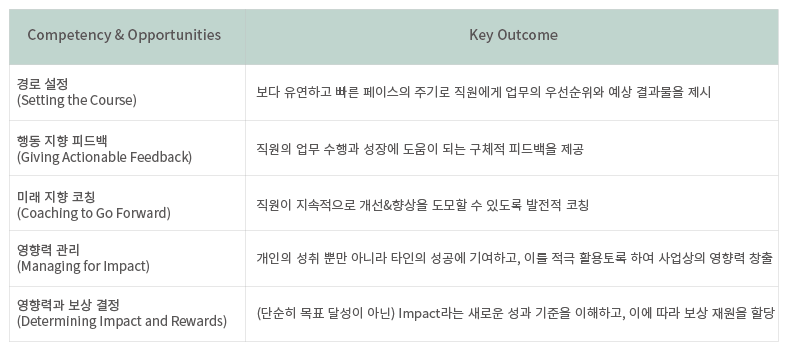
Capabilities and opportunities for agile performance management; key results
What HR really does is support the success and growth of the company and its employees. So if employees absolutely hate what HR does, and if it is not even contributing to the company's success, then something has gone very seriously wrong. Looking back, the evaluation systems we have had until now have generally been like that.
People often say in HR, "Evaluation is the most important thing." But the true meaning of this is often missed. Evaluation is the most important thing not because it produces ratings that determine all the rest of HR — rewards, promotion — but because the purpose, method, derivation, and use of evaluation drive employee experience and the perception of fairness, and ultimately, who receives a high evaluation and outstanding rewards defines the success and culture of the organization.
If that's the case, we need to seriously ask whether the practice of using year-end relative ratings centered on goal achievement to determine both rewards and promotion is really for the employees and the company — or for managers and HR. At the same time, we need to realize that one of the most important topics in HR today is implementing a performance management system that actually stimulates the creation of expected results and strengthens employee experience and engagement.
This article is about agile performance management, but the right answer does not have to be agile performance management alone, and there is no need to chase it as a fad just because everyone else is doing it.
What I do hope is that you will not dismiss this as a passing fashion of the era, that you will give it a serious look, and that this article becomes a starting point for thinking about the optimal evaluation model for your own company.