
Related Solution
HCG HR Solutions
hunel · JaDE · talenx — we propose the right HR solution for your organization.

Solve Complex HR Challenges with HCG
Talk to our experts
Insights
In a 2018 Forbes1 survey of around 500 senior executives, 90% answered that "organizational agility and collaboration are very important to future business success." As a result, the dominant question of recent years has been, "How can we build organizational agility and resilience?" In recent conversations with clients about agile performance management, I often run into the misconception that it is only possible in flexible, horizontal organizations like IT companies and startups.
Is agile performance management really only possible in agile organizations?
Agile Performance Management — Only for Agile Organizations?
Amazon reached its position as a market leader through innovative ideas and agile execution like "strategic agility" and the "two-pizza team." But its performance management is far closer to a traditional, relative-rating approach than to agile performance management. Orange Life, a pioneer of agile organization in Korea, also uses relative evaluation. On the other hand, companies that were once far from agility or agile organization — GE, IBM, Gap, Microsoft, Pfizer — have actively adopted and used agile performance management.
In fact, the two systems originally started from different places. Agile organization originated in the late 1990s with the Agile Manifesto and agile development methodology championed by a small group of IT developers who pushed back against the Waterfall development methodology suited to traditional manufacturing and construction. Agile performance management, by contrast, took shape from 2010, driven by innovative startups skeptical of traditional performance management and by leading legacy companies that had hit the limits of it.
Research2 on the recent evolution of evaluation systems describes agile performance management not as a "Revolution" — newly invented to "replace" the traditional evaluation — but as an "Evolution" that "complements" the weaknesses of the existing system.
HBR3 cites three reasons to abandon traditional annual relative evaluation: 1. the importance of talent development, 2. the need for organizational agility, and 3. the need to strengthen teamwork and collaboration.
In short, agile organization and agile performance management started from different places. There are companies that run agile organizations but stick with traditional evaluation, and companies that run traditional organizations but have introduced agile evaluation. In other words, agile organization and agile performance management are separate things — and even without an agile organization, you can build organizational agility through agile performance management.
Overseas, the transition to agile performance management took place rapidly around 2015, in response to external environmental change and to shift ways of working and culture. Many of these were traditional leaders that had felt threatened by emerging powers (Google, Netflix, etc.).
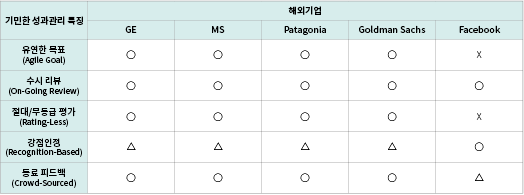
Characteristics of agile performance management at global companies
GE, in 2015, abandoned the forced ranking system it had popularized and adopted PD@GE4, focused on employee growth. Employees freely set their Priorities (goals), receive frequent reviews and feedback through Touchpoints, and at year-end, receive insights based on accumulated data. Notably, the system was originally rating-free, but ratings are scheduled to be reinstated in response to employee requests.
Microsoft transitioned to an Impact-based diagnostic system in 2014, in order to break free from internal cutthroat competition, promote collaboration, and reinvent itself as an innovative company. Employees typically hold three Connect Meetings a year, and before each meeting they receive a variety of feedback from three or four colleagues. They are then evaluated not on their own performance but on how much they contributed (Impact) to the success of others and to mutual success.
Patagonia recognized that its philosophy and culture did not fit the existing evaluation system, and from 2015 has run a goal-setting approach similar to Google's OKRs and Adobe's Check-in. Employees hold quarterly Check-ins with their managers and receive constructive feedback from an average of four colleagues.
Goldman Sachs, with the goal of strengthening talent acquisition and development by offering high-quality feedback to its best employees, transitioned from its existing nine-tier (1–9) evaluation centered on goal achievement to Feedback 360+, a three-tier, meaning-centered system based on continuous feedback about growth direction.
Facebook, despite being a leading global IT company, runs a Performance Summary Cycle that is closer to traditional evaluation. Managers hold weekly meetings and receive frequent feedback from peers, but performance is evaluated twice a year and ratings are derived through a group decision process that produces a seven-tier relative ranking.
In Korea as well, not only IT companies like Naver and SKT but also manufacturers like Hyundai Motor Group, POSCO, and Hankook Tire are actively adopting agile performance management. Korean companies, like their Western counterparts, are actively using continuous reviews and peer feedback.
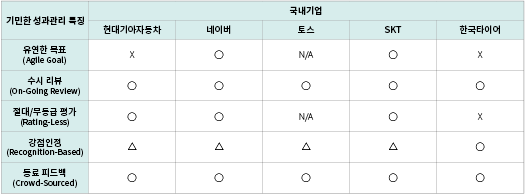
Characteristics of agile performance management at Korean companies
Hyundai-Kia Motors, while pursuing a transformation into a mobility company, abandoned its traditional one-way relative evaluation by supervisors and moved to an absolute evaluation method that strengthens continuous reviews and peer feedback through PSV5. It has also pursued various other HR innovations, including reducing job levels, abolishing promotion tenure requirements, and giving managers more discretion over rewards.
Naver runs the P-Review for feedback on annual work performance and the C-Review for capability development and stronger collaboration. C-Review in particular delivers direct, helpful feedback to colleagues through multiple-choice and open-ended questions and through pointed survey items.
Toss runs agile performance management using OKRs and is distinctive in that it has no formal individual-level evaluation — emphasizing collective performance and rewards instead. That said, it has built a culture in which colleagues regularly give each other feedback on capability and attitude, and in which one can directly call out ("Strike") issues that need to improve.
SKT runs People Review & Coaching (PR&C) year-round, oriented around fair evaluation from a development perspective. Based on the synthesis of review results, managers themselves directly determine rewards and promotion without separate ratings — a relatively dramatic HR system for a Korean company.
Hankook Tire has built a continuous performance management system (Live-on Chat) that strengthens evaluation and feedback on the work process. Leaders and employees communicate frequently and offer praise and encouragement for what is done well — strengthening both work performance and employee motivation.
The most common and important characteristic of agile performance management is continuous and collective feedback, and from this angle, some companies refer to agile performance management as "continuous" performance management. The underlying philosophy is to ease the formal procedures of existing performance management (e.g., goal alignment, rating assignment) and strengthen, in real time, the interactions that actually help with performance and capability improvement (e.g., reviews, coaching, feedback). This is effectively impossible with static paper or ERP performance management tools. Crowd-sourced feedback in particular aims to actively use the strengths of younger generations who are familiar with social media — so it is critical to set up environments where opinions can be exchanged easily and enjoyably (e.g., recommendations, comments, feeds) through mobile apps, like Facebook or Instagram.
Most leading global companies have their own performance management tools — Connect (MS), ACE (IBM), Check-ins (Adobe). Companies that find it hard to build their own use various commercial tools. Among these, Betterworks — built by former Google employees — is a market-leading app.
In Korea, SKT, Naver, and others already have their own tools, and Hyundai Motor Group and Hanwha Group are also known to have built or to be building their own. Similarly, commercial tools for companies that find it hard to build their own include Performance Plus, inHR, and StrategyGate — though the range of options is narrower than overseas.
Among them, Performance Plus supports the five major characteristics of agile performance management and is, on a mobile basis, a true agile performance management app that integrates work management and performance management.
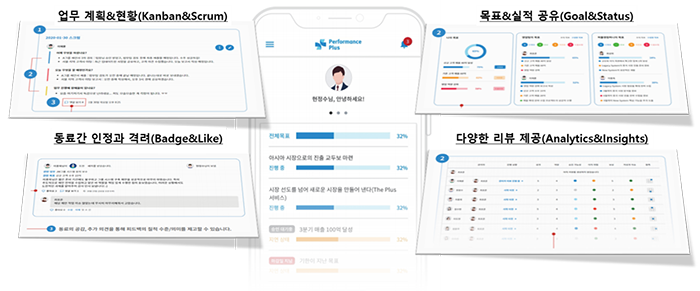
Performance Plus screen example
The success or failure of running a system depends on culture, but at the same time, running the system can also dramatically change the culture. If our organization is still hierarchical and rigid, instead of immediately attempting an agile organization or rating-free evaluation — both of which are hard at first — why not start with simple things like reducing job levels or activating peer feedback? Simply shifting the focus of evaluation from rating and ranking to communication and growth can let you see your organization gradually change.