

Related Solution
HCG HR Solutions
hunel · JaDE · talenx — we propose the right HR solution for your organization.

Solve Complex HR Challenges with HCG
Talk to our experts
Insights
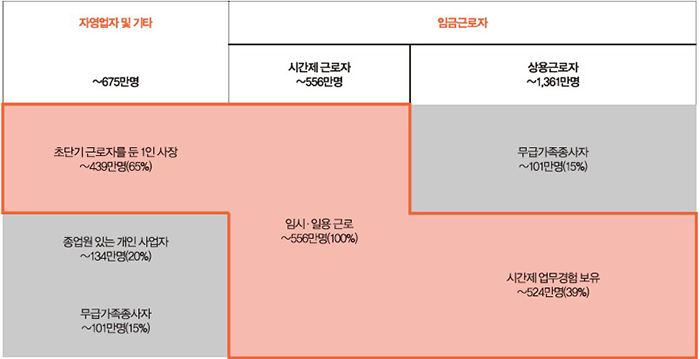
The gig economy has been expanding since the early 2010s, powered by the growth of platform services, and is establishing itself as a new pillar of the employment market. Statista, a global market research firm, reported that the number of gig workers in the United States reached approximately 68 million as of 2022, and projected that by 2028 the figure will exceed 50% of the US workforce, reaching 90.1 million. Korea is following a similar trajectory. According to Statistics Korea, around 10 million workers — roughly 38% of the country's 26 million total employed — are estimated to be gig workers. (See Figure 1.)
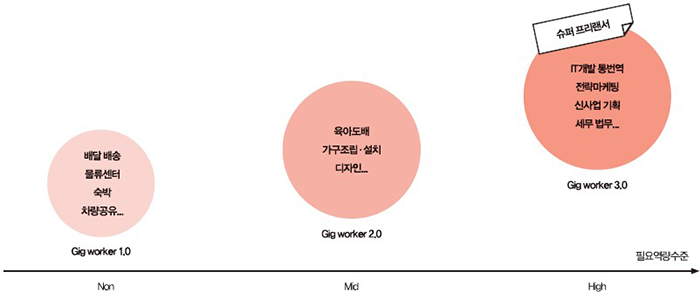
Gig workers are expanding not only in numbers but also in the range of work they perform. Early growth centered on low-skilled labor such as delivery, accommodation, and ride services, but the market has since extended into high-skill, high-expertise areas — strategy, marketing, design, development, tax, and legal — evolving into what is now called the "super freelancer" segment of business consulting. AI-driven gains in productivity and scope, better talent matching on platforms, and greater collaboration among gig workers themselves are all accelerating the growth of this market in both reach and scale.
The gig economy can also be segmented into several tiers based on the level of capability demanded of gig workers. Because the occupations, the nature of the work, the available talent pools, and the market origins differ across these tiers, treating them as a single phenomenon has its limits. Readers are therefore encouraged to keep this segmentation in mind as they consider the discussion that follows. (See Figure 2.)
Many forces are driving the rapid spread of the gig economy, but one of the most significant is the value shift from "workplace" (jikjang) to "profession" (jigeop). There was a time when a lifelong job was the gold standard. Phrases like "iron rice bowl" (철밥통) were used openly, and long-term employment, stability, and reaching retirement age were by far the top considerations when choosing where to work.
For the same reason, around 2010 there was a surge of young jobseekers preparing for civil service exams, and the hiring market was crowded with candidates chasing public-sector positions. Today, however, a lifelong job is no longer viewed purely as a positive. The current generation is ready to leave an organization the moment it stops delivering the experience and capability growth they want for their career path. Even inside large corporations, employees watch departing colleagues with a mixture of envy for those who can move on and frustration at being stuck — often chalking up their inability to leave to their own shortcomings.
This shift in how people value work has naturally fueled greater workforce mobility, and in turn the expansion of the experienced-hire market and the gig economy.
A paradigm shift in the nature of work itself has also helped accelerate the gig economy. In traditional organizations, employees belonged to a single company for long stretches, rotating through assigned duties while their work and development unfolded in parallel. But as business uncertainty grows and markets move faster, more organizations are operating on a project basis rather than through fixed, ongoing roles.
In this environment, individuals are no longer seen as owners of a particular job but as bundles of capabilities and skills, plugged directly into workforce planning as needed. In project-driven organizations with fixed timelines and clear deliverables, there is no room to wait for an employee to grow into the required level of capability; when internal resources are judged insufficient, external hires become the only option. In a similar vein, the preference for ongoing experienced-hire recruiting — over traditional new-graduate cohorts — reflects the same shift in how organizations operate, prizing immediate contribution to results.
In short, the spread of the gig economy is grounded in how today's generation views work itself and how work is performed — in other words, fundamental changes in both people and the nature of work.
We should not read the gig economy simply as a diversification of employment formats. It is better understood as the comprehensive result of sweeping changes in people and in work — and it demands a thoughtful, considered approach to the change management that needs to accompany it.
Work assigned to gig workers typically takes the form of short-term projects with clearly defined outputs and fixed timelines, so deliverable-based management is essential. Organizations need a concrete definition of the project's goals and what the end product looks like, so they can set precise expectations for the gig worker's deliverables and intended outcomes. Mid-project oversight should likewise be structured around deliverable-based milestones.
Equally important is building a communication and collaboration structure that makes the best use of internal resources. External workers cannot be expected to fully grasp the organization's existing processes or priorities, so establishing ground rules between gig workers and internal staff up front — around how the work should be done — is often decisive for a project's success or failure.
Full-time employees are no exception. Since COVID, flexible work arrangements have expanded dramatically, and dispersed workplaces and asynchronous hours are now part of everyday life. The old assumption that work means being in a set place during set hours — long considered the ceiling of what was possible for efficiency — has long since been overturned. Management built on visible supervision and real-time communication is no longer effective.
The question is no longer who is doing what, where, but who will deliver what kind of output, at what level of quality, and by when.
Returning to why the gig economy has expanded, one of the causes was the value shift from workplace to profession. This tells us that what matters today is no longer the external foundation of belonging to a company, but the internal foundation — the job capabilities and expertise — that lets individuals sustain themselves in a fiercely competitive environment.
From the organization's side, what it asks of its employees should likewise be growth through work, not loyalty-driven diligence and self-sacrifice. More than ever, companies need to treat their strategic initiatives as opportunities to develop their people. Seen through this lens, project-based assignments that include gig workers can become an open-innovation vehicle for broadening employees' experience and raising their capabilities. This is exactly why the allocation step matters — leaders need to think twice before pinning project outcomes entirely on external workers or handing over the most critical elements of the work.
Using gig workers effectively is important — but so is thinking carefully about the downsides of doing so. As in any organization, the instinct is to look inside before reaching outside. Yet at many companies, a lack of people-data makes it hard to identify the right internal candidates, and the urgency of the project pushes leaders to look externally far too quickly.
Bringing in external workers for short stretches has real upsides — a fresh perspective, cost efficiency — but we should not overlook the downsides when it comes to developing internal talent or managing change after the project ends. For that reason, any decision to use gig workers should be preceded by workforce planning tied to performance management, and by disciplined stewardship of the organization's people-data.
It is common to see workforce plans drawn up at the start of the year that bear little relation to the work the organization actually needs to accomplish. Such plans often end up as words on a page, with no operational follow-through, and by the time the work itself is due, the scramble to find people begins.
With deadlines closing in, internal resources never get a proper review, and the organization defaults to external help.
To make matters worse, HR and the business unit may then dispute whether the workforce plan had ever really been agreed, costing yet more time. By then it is already too late to screen external resources against the standards the organization wants and deploy them when they are needed. Given these risks, workforce planning tied to real performance management is essential — if only to secure and deploy talent on a stable footing.
If an organization wants to find internal talent with the right jobs and skills for a given project, it first needs a data-driven system for sourcing and deploying its people.
Almost any HR practitioner has, at some point, tried to reconstruct years of neglected records. Just as common is the sight of teams acknowledging how long the gap in stewardship has been, piecing together data that decades of record-keeping failed to preserve, and rebuilding the processes that should carry the work forward.
Given that the capabilities of its people are the capabilities of the organization, companies must hold firm to an internal-talent perspective — advancing the processes, systems, and institutions that accumulate, manage, and put people-data to work, all anchored in the value and the standards the organization seeks in its human resources.