

Related Solution
HCG HR Solutions
hunel · JaDE · talenx — we propose the right HR solution for your organization.

Solve Complex HR Challenges with HCG
Talk to our experts
Insights
In a workplace satisfaction survey conducted by Gallup Korea, HR systems (34%) and compensation/benefits (30%) posted the lowest positive response rates. (Coworker relationships 65%, job 59%, department atmosphere 56%, work environment 46%, senior leadership 45%, organizational culture 45%.) Going back to the same survey conducted in 2008, the shape of the results was no different. Even without extrapolating from the numbers, employee dissatisfaction with — or distrust of — HR has always been a live issue.
As if to break a pattern that keeps repeating more than a decade later, a strong wave of renaming and rebranding HR organizations has recently been sweeping through companies. People, Culture, EX (Employee Experience) — these are new names for what used to be uniformly called "HR" or "personnel."
Of course, negative perceptions of HR are not simply a product of the name itself. But it is worth paying attention to what value shifts are behind this renaming trend, and to the changes in HR's role and functions that follow from it.
HR renaming began overseas in the 2000s and has continued in Korea since the early 2010s, starting with startups.
The widely cited starting point is Google's use of the word "People" in its HR organization's name in 2006. In Korea, Woowa Brothers adopted the name "People Team" in 2013, and a symbolic case among large conglomerates is Samsung Group, which in 2023 dropped the word "personnel" (인사) from its organizational naming and switched to "People Team."
Before this renaming wave, a deeper shift was already underway in how workplaces thought about their employees. In the past, employees were seen as "organizational resources," and HR focused on managing them through tools like evaluation and compensation.
Once the promise — "perform, and the reward follows" — was made, the rest of the journey was effectively left to the employee.
(And of course, in many organizations, even the link between performance and reward was never consistently honored.) The result was that, aside from a small minority who actively responded to the performance-reward equation, most employees carried out instructions rather than engaging deeply with their work, and accumulated time-and-experience-based familiarity with their tasks rather than genuine growth in job capability.
Worse, it often triggered performance competitions that focused on looking good rather than on creating or improving real outcomes, because what people were chasing was the reward itself.
What dominated was "performance measurement," not "performance management." (This is exactly why process-oriented performance management has recently become a trend — but we'll leave the details aside here.) In the end, treating employees as passive resources and as objects of management, and running HR on evaluation and compensation alone, revealed clear limits when it came to "actively drawing out" voluntary participation.
Today, employees are being recognized as voluntary agents (People) or assets rather than organizational resources, and organizations are making "active efforts" to expand their positive experience (EX), enhance their happiness (Culture), and raise their capabilities (Talent). These "active efforts" drive higher organizational satisfaction and voluntary engagement with the work, and through what is commonly called "engagement," they set up two outcomes at once: growth in individual capability and the creation of performance.
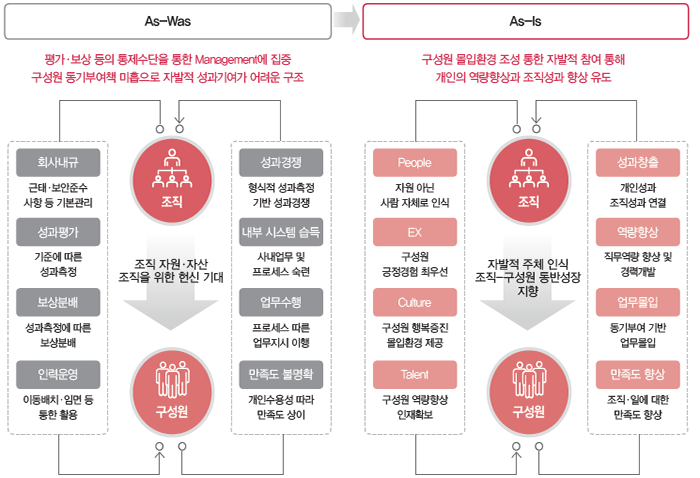
The keywords that appear in the renaming cases — People, EX, Culture, Talent — can be read as an intention, or a will, to capture exactly this shift in how employees are perceived, and the HR strategy that follows from it.
Meanwhile, Employee Experience (EX) is often described through the frame of an "employee journey" — hire, onboard, develop, promote, retain, exit.
In reality, this is not very different from the traditional HR frame: acquire, develop, evaluate, reward, retain, release. Even employee experience, in the end, is looking at similar events inside a similar frame — but the shift in perspective, from management-centered to employee-centered, is precisely what makes it stand apart.
It is natural to ask a deeper question: "Can an employee's happiness or positive experience really guarantee better performance?" Any executive involved in running the business is probably especially eager for an answer.
To get there, it helps to think about the characteristics of the MZ generation — the cohort driving today's workforce — and how companies manage talent around them. (The MZ conversation has been going on for a while now and is saturated with data, so we won't rehash it here.) In Korean companies, they are primarily in their thirties, and span roles from new hire to about early forties. Given that they are the hands and feet of organizations — owning the bulk of execution work, serving as the backbone, and driving the future — it is only natural that companies have become sensitive to them.
The MZ generation also places importance on growing alongside the organization, and they expect fair evaluation and rewards rooted in their need for recognition as individuals. The moment they feel they are not progressing or see no opportunity to progress inside the organization, they begin preparing to leave.
The traditional corporate culture — one that emphasized vague commitment and loyalty to the organization — simply did not have the levers to spark that kind of voluntary engagement, and persuasion and communication were uphill work. In the end, companies had to meet this generation's need for recognition through EX, personal capability development, and happiness, drawing out active participation and channeling it into organizational performance. Countless research reports have already described the proportional relationship between employee positive experience and organizational performance. In consulting, too, project requests centered on the MZ generation — organizational diagnosis, improving fairness in evaluation and rewards — have been coming in steadily for some time.
To summarize: if we think carefully about the traits of today's employees and what actually drives their growth and performance, the causal link between positive experience and organizational performance becomes sharper. In the end, this is just another way of stating one of the most basic principles of HR — that understanding people is the starting point and the precondition of running HR.
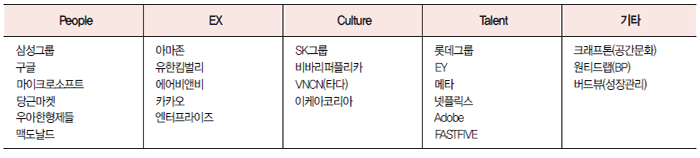
Table. Examples of HR organization renaming
Compared with the old organizational names, which were all derived uniformly from "HR" or "personnel," the new names take on more varied forms and more specific meanings. They embed the broader direction the organization wants HR to head in, or the core values it wants to preserve and strengthen. <See figure.> Put differently, the HR strategy is being "made visible through the organization's name," which in turn signals how much HR's strategic function is being emphasized. For years, the HR organization's role has focused on "Human Resource Management" in the literal sense — managing human resources efficiently. Inside companies whose first priority is business goals, resource management was a non-negotiable element.
But more is now being asked of HR than just its role as a management organization. It has been a long time since HR operated in a stable environment where management alone was enough. HR needs to be sensitive to rapidly shifting internal and external conditions, diagnose the root causes underneath surface phenomena, identify the essential ingredients and the obstacles needed to solve problems, and then deliver the solutions themselves — in short, it is time for HR to build problem-solving capability and process.
One tool that has emerged to build that process and capability is HR Analytics. HR Analytics can be summarized as the practice of using data analysis to surface key human-resources issues and to support the organization's strategic decision-making around solving them.
Many companies are now investing considerable attention and effort into strengthening HR's role as a strategic partner through HR Analytics.
One example is the HR Dashboard, which brings together real-time personnel statistics, organizational information, and individual capability data — the inputs needed to build a people strategy — and visualizes them in one place.
An HR Dashboard lets leaders monitor, at a glance and in a concentrated view, the key data needed for HR operations, and is a real asset in making decisions about how to manage the workforce. In major Korean conglomerates such as Samsung, LG, and SK, dashboards have been in place for several years now and are in the phase of being further refined.
The consulting industry is seeing growing demand for Process Innovation (PI) projects as well, and some clients are directly asking for dashboard design. Across many such projects, we have delivered not only monitoring-type functionality — workforce and productivity tracking — but also predictive functionality such as workforce structure forecasting and optimal headcount calculations.
We have walked through the root causes of the HR rebranding trend and the changes in HR's role and functions that come with it. If "renaming" is limited to changing the organization's name, then "rebranding" deserves the term only when a substantive change in role accompanies it.
As someone with hands-on experience in the field, let me add one thing: strengthening HR's strategic function calls not only for changes in how HR works — tools like HR Analytics — but also for securing the physical time to focus on strategic work. Many HR practitioners still spend eight hours a day, or more, on operational tasks, and have to push thinking about strategic work to the back burner. Sending a single company-wide notice can turn into a full day of answering follow-up inquiries. This is a challenge almost every organization faces, and it is one that has to be tackled preemptively — through structural changes, operational changes, or changes in how the work is done.
Finally, it is important not to forget that the shift in how organizations view their employees is ultimately about mutual growth — for the employees and for the organization — and, through that, about creating results for the organization.
Do not mistake higher employee happiness or a broader positive experience as an end in itself. More than anything else, HR change — including rebranding — must begin with clear understanding and genuine alignment on the shift in how we think about employees. That alignment is where it all has to start.