

Related Solution
HCG HR Solutions
hunel · JaDE · talenx — we propose the right HR solution for your organization.

Solve Complex HR Challenges with HCG
Talk to our experts
Insights
How long did it take for the transportation, communication, technologies, and services we use every day to reach 50 million users worldwide? The telephone took 50 years; television cut that to 22 years. The PC took 14 years, the mobile phone 12, and the internet only 7. Recently, the social network tools at the heart of social connection — YouTube, Facebook, and Twitter — passed 50 million users in just 4 years, 3 years, and 2 years, respectively.
The growth speed of new technology companies is accelerating to levels that are hard to predict. The average time for Fortune 500 companies to reach a $1 trillion market cap is 20 years. By contrast, the giant tech companies often called "unicorns" became dominant industry players in an average of just four years. Even Google, which reached the $1 trillion mark in eight years, was beaten by Uber (4 years) and Airbnb (3 years).
Accordingly, the corporate landscape has changed. As of 2001, the world's most valuable companies were GE, Microsoft, Exxon, Citigroup, and Walmart, in that order. Fifteen years later, in 2016, Apple, Alphabet (Google), Microsoft, Amazon, and Facebook had taken their places.
At the source of this change is digital innovation. The emergence and mutual combination of new technologies — internet, mobile, social media, 3D printing, cloud, AI, augmented reality — is changing not only the corporate ecosystem but also daily life itself. It connects organizations, people, and physical assets in new ways, and it generates massive amounts of data in real time. New customer needs emerge as a result, and these in turn accelerate the speed of innovation.
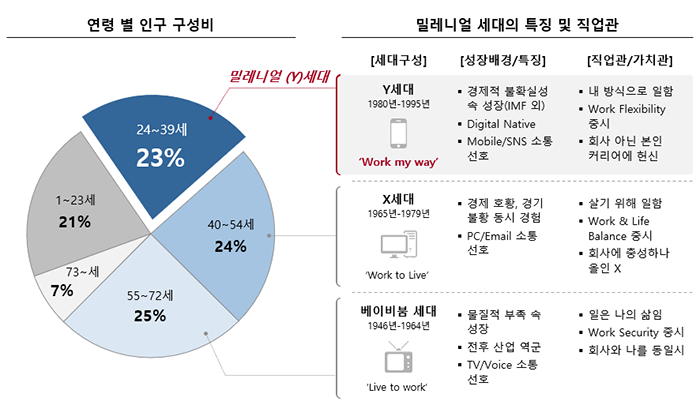
To understand digital-centered change, we must not overlook the emergence of a new generation. Born after 1980, the Millennial generation has surpassed a third of the economically active population and is the protagonist. This generation has been exposed to media from a young age, is comfortable with the latest technology, and has experiences and capabilities different from previous generations.
They have used computers since childhood and encountered virtual worlds through games. They are comfortable building and maintaining relationships through the internet, email, messengers, and social media. Millennials, who learn, play, and work online, are sensorially flexible and do not hesitate to embrace new things.
The generation often called "digital native" is driving the need for digital innovation in the workplace.
They are accustomed to sharing and communication, are favorable to new things, and prefer immediate responses.
They also value their own values more than common conventions.
In the workplace as well, they are more interested in their personal careers than in simple devotion to the organization, and they value meaning and enjoyment in their work.
Their desire for horizontal, free communication is large, so they prefer feedback grounded in development and recognition. They also tend strongly toward flexibility in where, when, and how they handle work.
And now an even newer generation — Generation Z, born after 1995 — will fill workplaces.
Digital transformation can be defined as the activity of fundamentally changing business models and strategies, processes and operating methods, organizations and communications, and systems through digitalized tools and technology.
First, change in the business model itself.
Kodak film was replaced by digital applications, Nokia sank under Apple and other smartphones, and Uber and Airbnb became the mainstream of transportation and accommodations. GE, the longtime king of traditional manufacturing, declared its transformation into a digital industrial company and increased its investment in engineering to 5% of revenue. In 2011, GE maintained about 250 people in its software research center; today it has about 28,000 digital specialists.
Goldman Sachs, the leader of investment banking, calls itself a technology company and has replaced about 40% of its total headcount with technology specialists. Through this, it protects the competitiveness of its existing core business while attempting a business shift in which products and services are expanded and replaced on a digital foundation.
Second, fundamental change in how customers are approached.
The core is moving from products and services to new experiences (digital experience), from large-scale services to extremely personalized customized services, and from ownership-based services to share-and-access-based services. All of these depend on digital-based technology.
Finally, innovation in how the organization operates.
This means using digital tools to make work processes faster and simpler and to build environments where people can work anytime and anywhere. Through this, the scope of communication is broadened and its speed accelerated, and a collaboration system that effectively shares information is built. The more transparent the work environment, the higher the quality of data secured — and the higher the quality of decisions that draw on it.
But simply introducing digital technology and applying it to the organization does not seem to lead these changes to success.
According to Leading Digital, published in 2014 with insights on digital transformation, companies with high digital capabilities but lacking the operational leadership to manage them effectively ("Fashionistas") recorded growth above the industry average (+6%), but their profitability actually worsened (-11%).
By contrast, companies that combined digital capability with leadership ("Digital Masters") saw remarkable improvements in both growth (+9%) and profitability (+26%).
One core of this digital leadership is ultimately tied to how organizations and HR should be changed.
Build a Culture That Fits the Digital Era.
The conditions for successfully driving digital innovation are very broad.
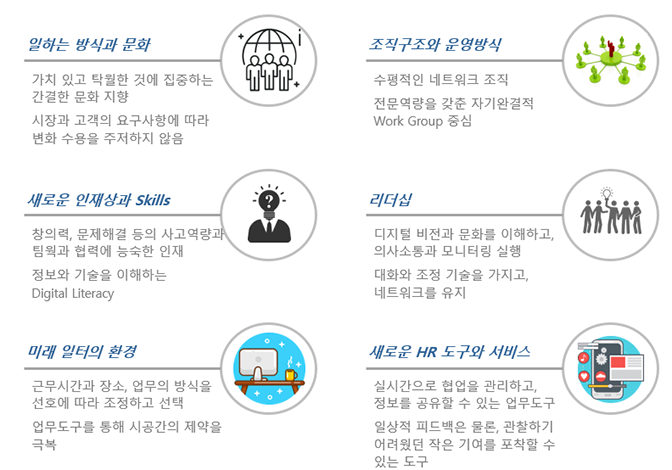
To lead sustainable change in particular, the right conditions must be in place — and the inertial DNA inherent in the existing organization and its members must be overcome. First, a culture that focuses on what is valuable and excellent is needed. Until now, corporate survival has been maintained by frames like the structural characteristics of an industry or the monopoly of information and technology, but those boundaries are now blurring.
It is significant that "disruption" — implying sharp severance and collapse rather than evolution — has become the term that represents the digital era.
A culture and corporate value that does not hesitate to accept market and customer demands and changes are essential. To do this, employee voice and participation must be natural, and a culture that respects the individual must be emphasized. As in society, collective intelligence and reflective thinking become great tools that connect a company's interior to the outside.
If You Want to Move Fast, You Need a Horizontal Organization.
If invisible culture is converted into a visible system, it becomes the organization's operating structure. The organization of the digital era must be structured around mission, market, and customers — rather than around simple work functions. Information and feedback must flow without obstruction, grounded in transparent shared goals and agreed operating methods. Hierarchies and multi-stage decision-making lines are therefore replaced by more horizontal network organizations. The obstacles that hinder the speed of decision-making and execution are removed, and the structure changes so that the organization can do its work in a self-complete way. The precondition for this is capable employees and leaders who are domain experts in their fields.
Reexamine the Standards and Perspectives for Looking at Talent
Digital innovation changes the capabilities and skills required of individuals. What people can do faster than digital tools or what is hard to be replaced — or what must be done together with digital tools — will become mainstream in the future. Accordingly, new standards and perspectives on talent need to be spread.
Skills related to ways of thinking — innovation and creativity, problem-solving thinking, curiosity and adaptability — must continue to be emphasized. In ways of working, the value of teamwork and collaboration is more important than ever. As the environment becomes more digitalized, it is hard for an individual alone to lift the value of work, so new value must ultimately be found through collaboration. In addition, the capability to work alongside digital tools is also needed.
Digital literacy — the ability to understand and use information and technology — is essential.
Leaders Without Fear of New Things, Who Are Inclusive, Are Needed
Whenever the demands of the times change, the area that faces the most challenging demands is leadership. To summarize the success formula of the digital era,
it is to (1) capture quickly, (2) execute quickly, and (3) make decisions based on sufficient information.
Capturing and executing quickly alone tends to lead to careless failure, and executing quickly based on a lot of information can sometimes lead the direction itself astray. Of course, searching only for sufficient information when faced with a new opportunity can also slow you down and let the opportunity disappear.
Thinking about where the risk of leadership failure hides like this tells us what kind of leader is required for digital transformation. Leaders, as decision-makers, must understand the new digital vision and culture, and not hesitate to acquire the language of digital business. The virtue of "learning agility" is becoming more important to leaders than ever. This becomes the foundation for not only quickly capturing opportunities but also making timely decisions. To effectively manage organizational operation grounded in horizontal networks, inclusiveness based on dialogue and coordination ability is also required.
The ability to understand and resonate with the individualized needs of talent raises the organization's execution speed and becomes the starting point for sustainable change.
HR Tools and Services That Fit the New Workplace Environment
In a workplace where employee collaboration and interaction with the external market are frequent, and where the flow and speed of information is faster, the work environment of the past is no longer efficient. The traditional office is itself fitted to a hierarchical structure and is not even good for collaboration. As a result, countless meetings and communication inefficiencies are pointed out. The offices of Silicon Valley companies — symbols of the new workplace — have no separate manager seats and almost no partitions to separate spaces.
Companies including NVIDIA put Post-it wall pads at every seat, so meetings can be held and content organized at any seat.
In an era of communicating through web and mobile, what is more important is collaboration tools that can overcome the constraints of work time and space.
Digital tools that share and accumulate information in real time and that anyone related to the work can access without restriction are now an indispensable condition.
HR services also go beyond the traditional HRIS — managing daily work and performance simultaneously and surfacing hidden contributions that have not been captured before.
The records of an individual's work history and the outcomes of interactions between individuals become valuable big data — the foundation for new job and career planning, development, evaluation, and culture management.