

Related Solution
HCG HR Solutions
hunel · JaDE · talenx — we propose the right HR solution for your organization.

Solve Complex HR Challenges with HCG
Talk to our experts
Insights
A few years ago, new terms began circulating: "gig worker" and "gig economy." Rather than describing traditional employment or labor systems,
they refer to workers — and the ecosystems around them — who provide labor on a sharing-economy model and receive compensation on the spot. Driven by platform technology, the gig economy grew rapidly around the peak of COVID and fundamentally reshaped traditional employment structures. Alongside Uber and Airbnb, Korean companies like Baedal Minjok and Coupang have been at the forefront of its expansion. According to a 2022 McKinsey study, there were roughly 58 million gig workers in the United States, representing 36% of the total workforce,
and data from Statistics Korea shows that, as of 2022, Korea had about 10 million gig workers — around 38% of its total workforce.
Against this backdrop, the arrival of generative AI — epitomized by ChatGPT in late 2022 — brought the gig economy to a new inflection point. If the earlier gig economy was powered by the rapid growth of platforms, the recent sweeping changes in the freelance market are being driven by AI, which is expanding what an individual can do and pushing personal productivity to new ceilings. According to a column from Harvard Business School published in HBR, demand for experts in document writing, coding, and similar work has fallen roughly 20–30% since generative AI appeared,
and those positions appear to have shifted to gig workers, who operate on shorter employment cycles. A study by UX consultancy Nielsen Norman Group found that using generative AI tools — on tasks ranging from routine business document writing to coding projects — can improve work productivity by 66%, and this improvement has completely rewired the labor structure in those areas.
In this way, advances in AI are not just improving company-level productivity; they are expanding the range of work an individual can take on.
As AI advances, not only is the scope of gig work expanding, but fundamental changes are also taking shape inside companies — in how work is done and how talent is managed.
Generative AI takes over, among the many inputs that drive "productivity," the activities required to "express" knowledge — replacing the "skill" input that used to turn ideas into finished outputs. As a result, employees will focus on creative and strategic work that only people can do. In some cases, by outsourcing the specialized knowledge needed to use those "skills" to AI, individual workers will be able to handle a broader scope of work on their own than they could before. If AI is combined well with remote-work tools, employees can complete their work end-to-end from anywhere using AI — which will in turn make their work environments and arrangements far more flexible.
HR and leadership will need to change along with this shift. As employees focus on creative, strategic work in flexible environments, performance evaluation has to focus on substantive contribution. The old model — observing and scoring employee behavior and attitude against fixed criteria from a control standpoint, then allocating resources through relative ranking and stack ranking — no longer fits the new way of working.
Measuring how much creative and strategic work someone has produced is inherently difficult, and in a flexible work environment, continuously observing employees is no longer the point. As evaluation returns to first principles — viewing actual contribution to the organization through the lens of "outcome" — rewards will need to shift as well, from the old model that tied differentiation partly to capability or seniority (skill level) toward one that puts much more weight on the real contribution delivered: the outcome itself.
Given that employees will be taking on broader scopes of work, the job architecture itself may need to change. Traditional job structures slice work into small, specialized units and manage them one by one, but the minimum unit of a job will need to grow as well. To encourage continuous expansion of scope, keeping job boundaries flexible rather than strictly fixed can be an effective approach.
Just as HR is being asked to change, leadership will face changes of its own. The old leadership mode — shaped by traditional HR, controlling headcount from a cost standpoint, and "deploying" employees through resource allocation — is unlikely to generate synergy with rapidly changing ways of working. This is the moment for a new kind of leadership, one designed to "lift up" employees who work alongside AI.
A Leadership Paradigm Shift: The Rise of People-Centered Leadership
One of the most notable shifts in the recent corporate environment is the changing perception of leadership. According to HR Exchange Network's 2025 HR Trends report, as the digital era accelerates, people-centered leadership — in other words, soft skills — is becoming more and more important in the workplace. (See chart.)
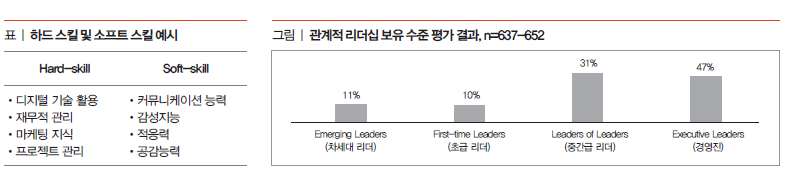
These leaders communicate most closely with employees inside the organization and play a critical role in shaping the work environment and the culture. They must therefore be more than managers — they need to act as facilitators who uncover employees' potential, support their growth, and connect the organization's goals to each individual's values. As the leaders with the most direct influence on employees, three soft skills are essential for carrying out this facilitator role effectively.
Leaders need to support employees as they extend their own capabilities on their own initiative and find deeper meaning in their work. The heart of this goes beyond simply hitting targets — it is about understanding and respecting each individual's values. Especially now, as the MZ generation moves into core roles in organizations, leaders must be able to explore with them the "meaning of work" they are pursuing, and draw out voluntary engagement.
When the organization's goals connect naturally with an individual employee's own goals, employees become much more proactive in engaging with their work. Leaders should set direction through ongoing communication so that employees clearly understand and resonate with the organization's vision and mission, and in doing so, help them see how the organization's strategy translates into specific actions — and how their own roles and contributions fit within it.
A leader's attitude and behavior set the tone inside an organization. For employees to take on new challenges without fearing change, leaders themselves must become role models who embody change and growth. They need to lay out a blueprint for the organization and inspire employees around both short-term performance and long-term career growth.
A leader's soft skills, in short, are expected to become a decisive factor in a company's future competitiveness. As advances in AI accelerate, people-centered values are, if anything, being pushed further into focus. The leaders who step away from task- and management-centered leadership and develop people-centered leadership instead will ultimately be the ones driving the corporate economy of the AI era.