

Related Solution
HCG HR Solutions
hunel · JaDE · talenx — we propose the right HR solution for your organization.

Solve Complex HR Challenges with HCG
Talk to our experts
Insights
As everyone expects, even after COVID ends, it is unlikely that gathering at the office every day to meet and report will become routine again. According to a PwC survey1, workers around the world have already grown accustomed to remote work, and working from home about half of the week (two to three days) is expected to become the new norm.
Although remote work is expected to become the new standard in the post-COVID era, there are clear differences in temperature across generations, companies, and countries. Generally, Generation X tends to prefer returning to the office, while the MZ generation hopes to continue working from home2. Among the FANG companies — synonymous with high tech — Google and Facebook plan to expand work from home, while Apple and Netflix actually plan to reduce or eliminate it.
Negative views on expanding work from home generally fall into two camps, and their reasons and motivations are quite different. The first is the case of Apple and Netflix: they hold that when employees who need to communicate and collaborate closely are physically apart, "creativity and innovation do not flourish." The second, often cited at Korean companies, is that with work from home, it is hard to actually manage whether employees are "working or resting."
This perception is also clearly visible in a survey by the Korea Chamber of Commerce3: while remote work was generally rated favorably in terms of work efficiency and employee satisfaction, when asked whether they planned to continue remote work after COVID, a striking 70.8% of companies said "not at all."
The newer generation (MZ) values the ability to decide its own work hours and location. If Korean companies simply strip away the option of remote work because of difficulties with attendance and performance management, the result will inevitably be a serious drop in employee engagement and recruiting competitiveness. Indeed, according to a recent HR Insight survey4, many companies see "creating performance in a remote environment" (27.3%) and "improving performance management" (18.1%) as their core HR priorities for 2021.
So what's wrong with traditional performance management — MBO-based annual relative evaluation?
According to CEB5, managers spend an average of more than 200 hours a year on activities related to annual evaluation, while 90% of HR leaders said "annual evaluation does not provide accurate information." In addition, according to the WSJ6, employees switch into "fight or flight" mode when they hear their evaluation rating.
Adobe has even cited the fact that, after year-end evaluations, a significant share of its employees experienced serious drops in engagement and ended up leaving — and that this was a key reason it abandoned its old annual relative-rating approach.
Even without citing complex research, a common complaint heard in the field is, "After evaluations end, the aftershocks inside the organization last for a month." Faced with results they cannot accept, supervisors say, "I tried to give you a good rating…" and reports say, "Why did I get a lower rating than that person…" — anger and avoidance of responsibility take over.
It is fortunate if it even gets discussed at all. At many companies, evaluation results are simply something you look up in the system, with no explanation or feedback at all.
Angry employees rush to look for new jobs, and evaluators are left scrambling to win back the hearts of employees who have already departed in spirit.
In short, traditional annual evaluation is something done only because the company says it has to be done — value or meaning are hard to find in it. It has long been reduced to a mechanism for deciding limited rewards and promotions, kept alive only because there is no good alternative. Combined with the perception that traditional performance management generates internal competition and lowers morale rather than improving performance, the rapid environmental change of the Fourth Industrial Revolution and the rise of agile organizations and the Millennial generation have further accelerated the shift to agile performance management — characterized by flexibility and horizontality.
According to HCG analysis, agile performance management has five characteristics that distinguish it from the traditional approach.
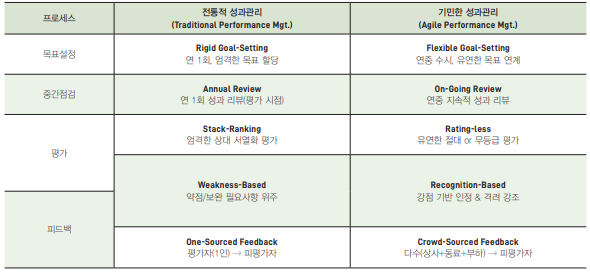
Differences between traditional and agile performance management
Each of these characteristics maps precisely 1:1 to a limitation of the traditional evaluation system. For example, rating-free evaluation prevents the psychological aftershocks that follow year-end ratings and helps strengthen developmental feedback. Setting goals on an as-needed basis helps respond to environmental variability and ease the difficulty of revising goals, while the use of collective intelligence resolves evaluator subjectivity and raises credibility. Emphasizing recognition resolves morale and conflict issues stemming from negative feedback and helps build a positive, collaborative culture.
Agile performance management is spreading among Korean companies as well, but not every company that has adopted it possesses all five characteristics.
In our consulting work, clients tend to broadly agree on the need for continuous review and feedback throughout the year and on the use of collective intelligence. As a result, POSCO and Hankook Tire run evaluation systems based on a supervisor's continuous performance management (continuous review), while Naver and SKT run performance management systems based on multi-rater peer review.
The characteristics of agile performance management that Korean companies have a harder time accepting are not setting goals at the start of the year and not assigning year-end ratings.
In reality, continuous review and feedback can be done perfectly well without setting goals. Even so, the perception that goals must be cascaded down to the employee level and tied to the organization, and that evaluation must be based on those goals, runs deep. Even harder to accept are absolute or rating-free evaluations. Won't absolute evaluation cause leniency or upward drift? How would you run rewards and promotion without ratings? For some, it is simply implausible.
SK Group has been leading innovation on multiple fronts. Company A within the group, which adopted absolute evaluation in 2016, says: "Contrary to general worries, quarterly reviews accumulated objective evidence and excessive upward ratings did not occur. If anything, sufficient evidence and conversation raised the fairness of evaluation."
Company B, which adopted rating-free evaluation in 2017, says: "By making rewards and promotion decisions freely on the basis of continuous and multi-source review without ratings, manager satisfaction and a sense of responsibility have improved."
So absolute and rating-free evaluation are no longer dreamy stories that only global companies can pull off.
As remote work has become more common, performance management based on attendance and process, as before, has become harder, and companies are strongly feeling the need to maintain productivity and to manage performance based on objective results.
While the answer must come in the form of results, achieving the desired results requires a paradoxical situation: "process management at a level that does not feel like interference or distrust" combined with "development through appropriate intervention and advice." This is exactly where agile performance management proves its validity.
1) Agile performance management aligns daily work with performance goals. Rather than goals decoupled from the actual work and set just for the sake of evaluation, goals and expectations are agreed with the supervisor and executed on a frequent basis (every two weeks to a quarter).
2) Agile performance management strengthens timely feedback. Year-end feedback is one beat too late. What employees need is neither a supervisor nor an audience but a playing coach who can give the advice they need as they need it.
That agile performance management is optimal for remote work is best evidenced by the fact that it is already common at global IT companies that pursue "anytime and anywhere" work.
According to BetterWorks7, an agile performance management vendor, companies that transitioned to agile performance management "maintained 31% higher productivity throughout the year" compared with those that did not. Agile performance management is a very good way to make performance evaluation neither an annual ritual (Too Long) nor frequent surveillance of remote workers (Too Short) but a natural, repeated part of everyday coaching and process management.
In the end, four things are needed for successful remote work: ① a clear company policy on remote work, ② digital infrastructure that promotes communication and collaboration, ③ systems and tools that can manage work and performance in an agile way, and ④ manager leadership that can clarify expected outcomes and coach efficiently.
Are our employees really not ready to accept agile performance management? Or is it the company that is not ready, assuming in advance that they are not? If you are still holding on to traditional performance management, I urge you to start preparing for and adopting agile performance management — the new normal — even now.
1) PwC, "It's Time to Reimagine Where and How Work Will Get Done"
2) Deloitte, 2020 Millennial survey
3) Korea Chamber of Commerce, Survey on Changes in Work Patterns After COVID-19
4) HR Insight, "Adieu 2020: Report on HR's Major Activities"
5) Washington Post, "Accenture will get rid of annual performance reviews and rankings"
6) Wall Street Journal, "How Performance Reviews Can Harm Mental Health"
7) Betterworks, 2019–2020 State of Continuous Performance Management Survey