

Related Solution
HCG HR Solutions
hunel · JaDE · talenx — we propose the right HR solution for your organization.

Solve Complex HR Challenges with HCG
Talk to our experts
Insights
From the moment an employee sees a job ad to the moment they leave the company, everything they see, learn, and feel contributes to employee experience. To raise the level of employee experience, an organization must listen to employees at each stage of their work life, identify what is meaningful, and deliver personalized, tailored experiences. In a world where you can no longer expect employee initiative through monetary rewards alone, focusing on employee experience is one of the most promising sources of competitive advantage.
The shift from the traditionally emphasized employee engagement toward a holistic employee experience is being driven by a variety of factors — demographic change, social media, and the increasing volatility of the economy.
The Millennial and Gen Z generations want more opportunities to express their views.
We need a deeper understanding of these new employees who feel, think, and act differently from previous generations.
The war for talent is more intense than ever.
The number of candidates for fewer jobs is rising, but the market competition for the talent companies actually need is intensifying. Employee experience is one of the last ways to differentiate yourself as an attractive employer.
Companies are being asked to change faster than ever.
An economic environment has arrived in which digitalization, agile management, and the emergence of new products and services that completely reorganize the market — to the point of being called "disruptive innovation" — are the norm. Companies are expanding or contracting at a faster pace than ever before. We need to regularly observe and understand how employees are actually being affected at every moment they experience change.
Expectations for personalized experience are growing.
Just as they experience the products and services of B2C brands as consumers, employees expect to be uniquely treated and engaged with inside the organization.
As social-media-based information sharing has exploded, the risk that a company will be exposed to a kind of reputation virus has grown.
The best way to protect your own employer brand reputation is to keep the workplace more transparent.
Several important elements shape employee experience from the moment a person sets foot in an organization, journeys through their work life, and leaves.
Jacob Morgan, author of The Employee Experience Advantage, highlights several elements that shape the environment of employee experience regardless of organization size.
Culture
Defining a company's culture is hard. Culture is the very words of leaders, including top management, and it is also the official mission and values.
It also includes the actual practices in reality and how the company responds to employee attitudes. Sometimes, it is how employees relate to the people they work with directly when no manager is around. Everything is mixed together — leadership style, organizational structure, the definition of success. The definition is hard, but employees experience culture just from the atmosphere they feel when they work. Culture can motivate, energize, and empower an employee — but it can also leave them shrinking and feeling left behind.
Technology Environment
Organizations that think about the future of employee experience must invest in the right tools and environments that let employees do their work efficiently. The technology environment is not limited to supporting a convenient work environment — it is also a medium for improving individual capabilities and social skills. The recent technology environment is advancing broadly, making it easier than ever to provide the tools employees need to feel confident in their roles.
Physical Workspace
Employees who are satisfied with their work environment have better focus and higher productivity. They also feel it as one of the more attractive benefits. The physical workspace is not always at the office. The autonomy to work from various spaces — including one's own home — beyond the office can also contribute to a positive employee experience.
In proportion to the advance of the technology environment, the boundaries of the physical workspace expand.
Building on these foundational environments, we can define an extended model that covers the elements that shape employee experience (Shapers), the tangible and intangible manifestations (Vehicles), and the outcomes. Through it, we can measure the organization's employee experience readiness and level.
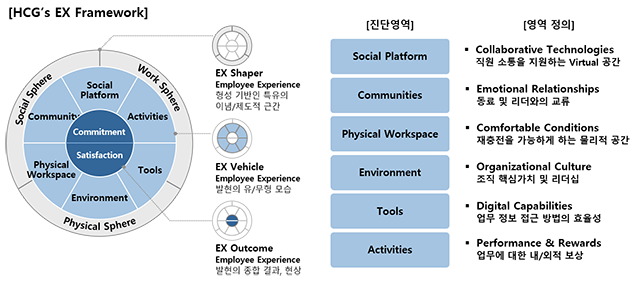
Many research findings show that improving employee experience affects every part of the business. Employee experience and engagement levels are known to be the best indicators for predicting business unit productivity and financial results, as well as the level of customer experience. Companies with high employee participation grew revenue more than 2.5 times that of companies with low participation (Bain & Company).
Also, employees whose engagement was raised by positive experience are 87% less likely to leave the organization than those without it (Corporate Leadership Council).
This reduces the cost of recruiting new employees, growing them, and waiting for them to fully exercise their capabilities. While 70% of highly engaged employees say they understand how to meet customer needs well, only 17% of those who are not engaged say the same (Wright Management).
Employee experience covers every moment from when an individual joins an organization to when they leave. The starting point is the time and cost of hiring, the offer acceptance rate, and the quality of the hire at the new-hire stage. This includes everything from whether you attracted the best candidates with an appealing and clear job ad, to their experience in the selection process, to whether the targeted applicant group accepted offers quickly.
After joining, employees go through the process of quickly grasping the organization's systems, tools, and processes and meeting role expectations. Most employees need a "honeymoon period" to shorten their working time and raise productivity. Obviously, the faster they can do their work, the better for the organization. Effective onboarding sparks an employee's eagerness for their new role and turns it into a meaningful relationship with the organization — and the resolve to do great work while they are there. The pace at which employees develop within their role differs slightly. Identifying what skills and capabilities they pick up along this journey, and what they want, is also important content.
Employees need a "portfolio career" composed of various experiences for their growth, and the organization must seize opportunities to provide differentiated experiences to many employees.
Once employees are organized to a certain level, the company's challenge is to maintain the pace of their contribution and development for success. They also need to be inspired by the company's vision and values. Doing your best to retain existing organized employees, rather than replacing them, is also economically rational.
Employees may leave for various reasons. Knowing at what stage they leave and why is a valuable opportunity to improve employee experience for current and future employees. Brutally, the people who are leaving feel they have nothing to lose and can give honest opinions.
Overseas companies like IBM and GE use digital tools from the recruiting stage to raise the level of employee experience while building monitoring systems that can quickly detect problems. They focus on letting employees conveniently meet their own needs and, as needed, place dedicated organizations and specialists to deliver tailored experiences. Through this, they aim to protect both individual-level growth and organization-level value and culture in a way that drives forward.
Combining Operational Data and Experience Data
Companies have "operational data" — from employee personal histories to evaluation and reward records. The movement to combine this with "experience data," in which employees tell us about their experience, in search of new insights is accelerating. The opportunities to deeply understand what is happening in the company and why, what to improve, and — for activities that take the same time and cost — what value employees feel and prefer will continue to expand.
Listen and Measure Every Day
Interest in what employees do and feel every day is rising. Learning new things, simplifying repetitive practices and tasks, and trying new methods to improve performance — all of those are great employee experiences. We can also understand that there are different views and opinions on the same experience.
Listening to opinions through regular surveys (pulse checks) — including annual ones — and open feedback platforms is becoming an essential management activity. Going further, attempts to understand how employees view the issues they face moment by moment through short, brief questions and to gather rich data will continue.
Attention to and Investment in the Workplace Environment
The workplace environment does not just mean a flashy headquarters and a new interior. It can be the autonomy of time and space, authority over small service decisions, and everything employees want to be included in their work space. Interest in not only the internal workplace environment but also how their workplace relates to and contributes to society and community is also rising. Internal and external pride is one of the ultimate things employee experience pursues. The result of this attention and investment is most effective when it is easy to understand and disclosed transparently.
Understanding how employees feel as they experience the workplace, grow, and leave is the starting point for raising employee experience. What is meaningful and what is not? What experience is positive and what can the company improve first? Surveys to answer questions like these need to be conducted more periodically and systematically.
From candidate reaction surveys and onboarding surveys that monitor the joining process and post-joining adaptation stages, to training feedback surveys, 360 reviews, and pay-and-benefits optimization surveys to learn about employees' growth and recognition experiences — measurement using the right tool at the right time is needed.
As we have seen, the trend in surveys about employees' experiences and feelings is shifting toward more frequent, more concise structures. The real-time snapshots of company-wide morale and employee satisfaction obtained through this enable more effective intervention. Investing small amounts of time and cost at the moments they are needed is far more effective than investing large amounts of time and cost in a one-off effort. Furthermore, employee experience has, by its nature, a personalized, customized character.
If small success experiences are repeated, the level of employee experience can be expected to rise.