

Related Solution
HCG HR Solutions
hunel · JaDE · talenx — we propose the right HR solution for your organization.

Solve Complex HR Challenges with HCG
Talk to our experts
Insights
Executives are often called "the flower of the working life." The phrase carries the envious sense of the high authority and benefits that come the moment someone becomes an executive — but it is also shorthand for the unlimited responsibility and burden each executive carries for the company's performance and sustainability. Recently, the wind of change has begun to blow over the executive organization.
It is no longer just the next step you eventually reach by accumulating performance at the top of the employee ranks. The standards for how executives are managed — as the true core leaders of the organization — are becoming stricter. The reasons our organizations could collapse if they don't change right now are many: long-term low growth, the Fourth Industrial Revolution and digitalization, post-Corona, and more. And the central axis that can lead a company's fundamental change is still the executives — the helmsmen of the organization.
This article looks at the current trends on a few of the more notable themes among the changes happening in and around the executive organization recently.
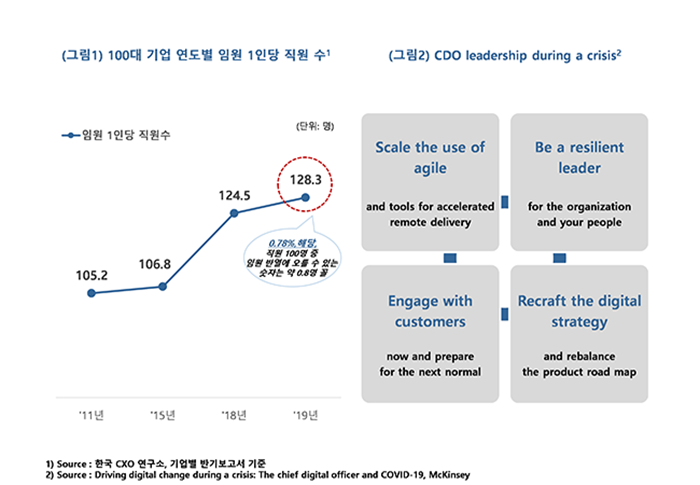
The size and the number of decision-making levels for executives are gradually shrinking. According to a survey by the Korea CXO Institute (Figure 1), the number of employees per executive at Korea's top 100 companies has been steadily increasing over the past 10 years. Assuming the total size of the organization stays within a certain range, this means the executive headcount is gradually decreasing. Reductions in executive grade are also actively underway, especially at large companies.
SK Group made the relatively dramatic move of abolishing executive grades altogether. Hyundai Motor consolidated three steps — Acting Director, Director, and Senior Vice President — into a single Senior Vice President level. Korean Air consolidated Senior Vice President and Associate Senior Vice President into Senior Vice President, and Executive Vice President A and B into Executive Vice President — while creating a new employee-level title, Chief Senior Manager, to simultaneously reduce the number of executives and shore up the front-line workforce.
If we can treat these cases as a general trend, what is the cause, and will it continue?
Some of these cases can be seen as workforce efficiency efforts to overcome a crisis like the industrial slowdown caused by COVID-19. But the more fundamental cause is more reasonably found in the demand for organizational structural change driven by changes in the business environment.
To respond to the rapid and unpredictable change of recent years — represented by VUCA — most companies, regardless of industry, are trying to build agile organizational operating models internally. The core of agile is fast decision-making, which inevitably leads to organizational consolidation and slimming on the structural side.
In a slimmer organization, the room for executive positions — and therefore the size of the executive headcount — naturally shrinks. From the same angle, multi-layer "roof on a roof" job level structures can act as the biggest obstacle to fast decision-making, so the direction of further reduction is expected to inevitably continue.
The jobs and roles required of executives also change with the times. The Talent War that began in the late 1990s and continues today asked HR to play a strategic partner role to top management, which became the trigger for most companies today to operate a CHRO (Chief Human Resources Officer) — strategically leveraging internal human resources at a higher level. In the same way, the recent Fourth Industrial Revolution and the digitalization needs that come with it are strongly demanding the role of a CDO (Chief Digital Officer) — someone who can centrally lead and drive change inside the company.
Globally, discussions about the importance and role of introducing a CDO have been actively underway for several years now. Market research firm Gartner has published findings that about 15% of major global corporations currently have a CDO.
Some may view this as still a low number, but considering the recent explosive growth in demand for digital products and services driven by COVID-19, the urgency of digitalization and the need for a control tower can only grow.
There are already many cases of digitalization being successfully driven through the introduction of a CDO. Microsoft — a representative IT company — successfully transitioned from a software-centric company to a mobile/cloud services company, and Starbucks — a traditional food and beverage company — successfully digitized from offline to online by introducing mobile ordering and payment. Both were possible only because the companies recruited capable CDOs at the time and gave them full authority.
Compared with this, the response of Korean companies has been relatively slow. While some major conglomerates in electronics and automotive have built dedicated organizations, the questions of "who," "what," and "how" remain unclear. Because the CDO is a relatively recent concept, there is in fact no clearly agreed role definition.
So companies considering the introduction of a CDO need to define the CDO role they need by considering their own digitalization status and internal dynamics (especially the role distinction with the CIO and the reporting structure). On that score, the recent McKinsey report on CDO leadership in the post-Corona era (Figure 2) is worth referencing as a fitting picture of the CDO at this moment.
The single most important task of an executive is making the management decisions a company's activities require. For that reason, clearly defining the scope of decision-making responsibility is critical to defining how an executive works. Traditionally, there was a period when executive responsibility was understood as the "management" of a business or organization. The widespread emergence of the C-suite today expanded the type of responsibility executives carry to also include "expertise" in the company's core functions.
The recent business environment is asking executives to go beyond fulfilling the responsibilities they have traditionally been given and to collaborate as a single team with other executives.
For example, the heightened demand for end-to-end customer experience across a product calls for organic collaboration between the CMO (Chief Marketing Officer) and the CTO (Chief Technology Officer). Similarly, when company-wide innovation like digitalization is needed, the CDO mentioned above must work in combination with the CMO's judgment about the level of market and customer demand and the CFO's judgment about financial effectiveness.
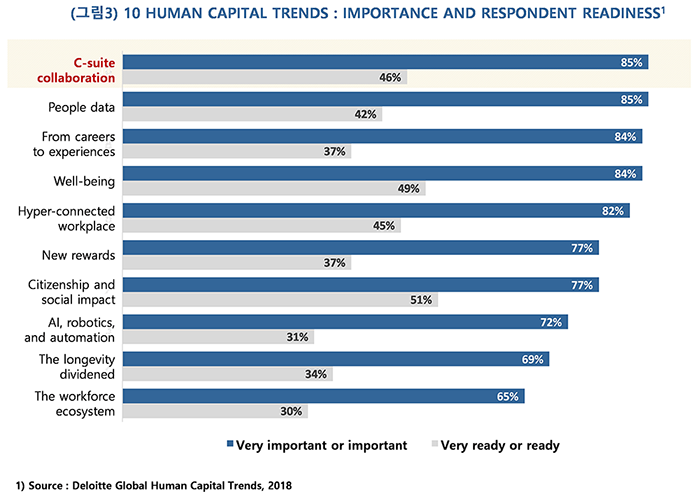
A recent Deloitte study clearly confirms this shift in perception. In a survey with more than 11,000 participants, about 85% of respondents named C-suite collaboration as either the most important or one of the important challenges. If executive collaboration is needed, here are a few things to think about first to draw it out.
First, clarify the tasks that need collaboration. Cross-executive collaboration is not essential in every area, and fulfilling original responsibilities should always remain the foundation.
Second, structure the collaboration system. Realistic and concrete thinking is needed about who will hold the lead, and how to operate things like governance bodies. Finally, an HR-policy-level approach is worth considering. If you tie evaluation through to compensation, it can become the strongest motivator for individual executives. As an example, Walt Disney determines 70% of an executive's evaluation by the performance of their own business unit and the remaining 30% by the synergy revenue created through collaboration with other business units — using economic incentives to drive cross-executive collaboration.
Among Korean companies, POSCO recently defined the competitiveness of manufacturing in the digital era as cross-organizational collaboration, and introduced a "Collaboration KPI" into executive evaluation to promote it. This case can be understood in the same spirit.
In a rapidly changing environment, the ability of executives to navigate that change is a company's competitiveness. The system that manages executives must be able to reflect social and economic change more sensitively.
If your organization needs fundamental change in things like agility and digitalization, turn your eyes back to your executives. Are our executives ready to be leaders or enablers of change? In the process of finding answers to questions like these, the context behind the few trends introduced above will become clearer.
Every change has a reason behind it.