

Related Solution
HCG HR Solutions
hunel · JaDE · talenx — we propose the right HR solution for your organization.

Solve Complex HR Challenges with HCG
Talk to our experts
Insights
Workforce planning is always a hard subject for HR. It carries the somewhat abstract difficulty of reducing people — each an individual — to numbers, and whether the outcome is a surplus (+) or
a shortage (−), the adjustments that follow have an outsized impact on employees' futures. That said, from the point of view of both the company and the community of employees, a company's survival is the indispensable precondition for employment — so maintaining the company's sustainability through appropriate workforce planning is clearly necessary work.
Workforce planning is, in the end, a game of supply and demand. The core is identifying the major drivers that determine supply and demand — the macro business environment, the internal capabilities needed, the external talent market — and turning them into a long-term workforce operation strategy. Every company has its own concerns, but several current trends show up as distinctive features of Korean companies.
Experts are nearly unanimous in predicting a macro crisis of low growth driven by the collapse of global value chains from the Russia–Ukraine military conflict, inflation, a rapid rise in the exchange rate, and a slowing economy. As a lagging indicator that moves in tight lockstep with company results, demand for labor is naturally going to fall. And with raw material costs rising, the pressure to cut headcount to reduce cost of goods sold is mounting. If restructuring driven by the industrial paradigm shift set off by COVID-19 brought both crisis and opportunity depending on a company's constitution, the recent situation is a global economic crisis affecting entire industries — and the depth of every company's concern about whether it can still afford to sustain employment is growing.
Even global leader Google recently discontinued its cloud gaming service as part of a plan to raise efficiency by 20% through workforce reduction. In Korea, too, consulting inquiries from companies that are continuing business restructuring started over the past several years — or that are planning new restructuring — are growing sharply.
I said earlier that workforce planning is a game of supply and demand, but in certain industries — especially IT — demand has continued to overwhelm supply. The Software Policy & Research Institute of Korea has projected that over the next five years, there will be an average annual shortage of about 6,000 new software workers.
For several years, the talent war in IT has been so intense that "if someone has a specific skill, just hire them first and sort it out later" is not far from reality — never mind distinctions in expertise level.
Demand for IT-related talent is also showing up in functional roles inside other industries. According to a Bank of Korea study, headcount at major Korean financial companies fell 0.7% year on year, while IT headcount rose 12.4%. Now that the first wave of the talent war has passed, something interesting has started: IT companies are beginning to separate the wheat from the chaff.
IT compensation has risen to levels that put pressure on company results. So alongside bringing in the specialists they need from the outside, companies are also running internal capability diagnostics to assess expertise levels and to differentiate compensation accordingly.
Even companies that are not yet thinking about enterprise-wide restructuring are now prioritizing workforce efficiency around low-value work. These activities do not directly affect core company capability, and — simply as a consequence — the average value per employee ends up rising.
Replacing simple, repetitive administrative work is particularly active. Outsourcing the people themselves can deliver cost savings, but what has been drawing more attention lately is RPA (Robotic Process Automation), which replaces the work itself with a system rather than with a person.
In the past, automation was limited to repeating structured data work in a standardized process. Recently, RPA has advanced to the point where it can fully replace a single person's work — aggregating structured data, processing it, writing reports. Empirical data on the time (and headcount) efficiency gains from RPA adoption is also piling up. Retail company N officially announced annual savings of about 30,000 hours after adopting RPA; financial company L announced about 20,000 hours.
Strict management of individual low performers who can affect company results — and the outplacement system supporting it — is being strengthened.
Large-scale restructuring and voluntary separation programs inevitably carry the side effect of losing core talent the company should be retaining.
For that reason, unless a company is facing an unavoidable and imminent business risk, the most desirable approach is to pursue both the appropriate workforce size and the preservation of human capability simultaneously, through a continuous, routine low-performer outplacement program. Until now, many Korean companies have lacked formal systems to manage low performers, or if such systems exist, they have often not been properly run.
The reasons are a mix of distorted and distrusted evaluations driven by Korea's long-standing seniority-based paternalism, and the complex legal and procedural interpretations that have generally been judged insufficient to justify dismissal. But for the MZ generation — which emphasizes fairness and demands transparent recognition of performance — treatment proportional to performance, including exit, is increasingly accepted as natural.
Alongside this shift in employee perception, companies are also beginning to manage low performers more strictly than in the past. Specifically, the focus is on introducing continuous performance management systems that make it easier to document long-term low performance, and on designing Performance Improvement Programs (PIPs) that secure legal and procedural legitimacy.
Workforce planning is not just a simple number on an org chart. Beyond producing a compelling answer to what the appropriate workforce size is — using the best methodology for the company's specific character — workforce planning in the broader sense also covers every activity that improves efficiency through qualitative change in the internal workforce. If you are thinking about workforce planning, whether as a one-off or as a regular exercise, the following points are worth keeping in mind.
When people think of workforce planning, most immediately think of job analysis — measuring the time required to perform each task and setting the required headcount from the arithmetic result. This may be the most optimal method for an organization like production, where standardized tasks are performed repetitively on precise timing. For organizations that are not like that, though, it is worth actively searching for a methodology that fits the company's own business and organizational/functional character.
For example, for a business centered on branch-level sales, Data Envelopment Analysis (DEA) can be useful for each branch's workforce planning. DEA, put simply, is a method that uses data to identify the most efficient organization, then measures inefficiency by how far each other organization is from it.
(See Figure 1)
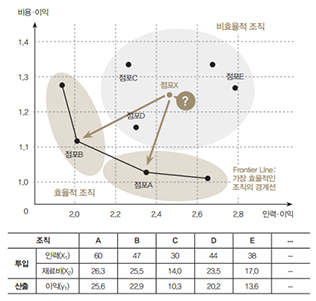
Using this, each unit organization can easily set a workforce size target proportional to the inputs and outputs of the most efficient organization. For organizations performing enterprise-wide support functions, such as HR or finance, a Staffing Ratio — the optimized ratio relative to the size of the population being supported — can serve as a first-pass guide.
For example, at a company with fewer than 250 people, you can take the average of roughly O HR staff per 100 employees as a benchmark and combine it with other methodologies. There is a body of research accumulated by major support function, so it is worth referencing that work.
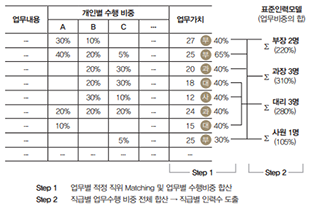
When high-level inflation has set in to an extreme degree and the internal workforce structure has broken down, an approach based on job value may be needed. By analyzing the gap between current workforce operations and a standard workforce model where work value and the level of the person doing that work are proportional, you can get ideas for workforce planning that take future workforce structure into account.
(See Figure 2)
Benchmarking against competitors in the same business can also be a useful source. Not only is it possible to compare functions directly thanks to high organizational-functional similarity, but if the market has oligopolistic competition, differences in workforce size are likely to show up as differences in business results — making this data highly valuable as a basis for workforce planning.
Strategy execution comes before operational efficiency. The most common error made in workforce planning is to try to plan every organization and every headcount.
From a formal-equality perspective, not allowing exceptions may prevent conflict — but it can become a shackle on flexible workforce operation.
For example, for an organization running a new business that will decide the company's future, rather than focusing on efficiency-based workforce operation grounded in current value, a strategic decision may be needed — deploying the best talent in the company at a headcount above the average. HR should step back and ask again what the purpose of workforce planning is, and avoid the mistake of confusing means with ends. Sometimes, leaving room for managerial judgment to operate — rather than producing a tightly reasoned logical conclusion — is actually the closer path to real reasonableness.
Something that must not be overlooked in workforce planning is this: while maintaining the appropriate workforce size (the quantitative side), we also need to reconsider the capabilities of our internal people and put them to use properly (the qualitative side). Only when we can maintain our current level of company capability at a reduced headcount can we prepare for the future.
Job transitions and capability development are not new concepts, but they are the most important elements in leveraging internal talent. To make this happen, we need to redefine what our company's internal capabilities are, assess where each employee currently stands, and then develop what is lacking — while also actively redeploying people where there is a mismatch.
As a recent project example, Company A built an enterprise-wide skill set, then directly linked and embedded the resulting skill-gap development plans into the performance management process as goals — securing consistency and momentum. In another example, Company H used the internal expertise data it gathered to build a Job Matching system, creating a physical foundation that could actually be used for job transitions.
If workforce planning had to be described in a single phrase, "it is art, not a technique" might be the right one. The result — expressed as numbers on an org chart — needs to condense HR's holistic thinking, from business strategy and character
to the differentiated use of internal talent. Only when it does can workforce planning — which is always going to be dissatisfying to someone — earn its legitimate persuasive weight.