

Related Solution
HCG HR Solutions
hunel · JaDE · talenx — we propose the right HR solution for your organization.

Solve Complex HR Challenges with HCG
Talk to our experts
Insights
The changes brought by COVID-19 have been serious enough to alter the way the civilization we have built operates. By a great fortune within the misfortune, humanity had over the past several years acquired the knowledge — through advances in information technology — that would become the key to overcoming it. To push humanity to the limits of efficiency, information technology has developed mobile devices that connect from anywhere, and it has built broadband communication infrastructure that can transmit and receive high-resolution video and voice and large volumes of data.
That is not all. Once the computational power of computers reached the possibility of surpassing human judgment and calculation, we began teaching them with data. Through "artificial intelligence," humanity proved that machines could decisively defeat people even at the game of Go.
The technology side has advanced spectacularly, but trust-building inside the workplace has remained slow. We were still arguing back and forth about how to make people work 52 hours a week, and we were still hesitating to allow flexible working hours and work from home. To evaluate employees, face time and personal experience mattered more than work data. We had been doing things this way for nearly 30 years.
It was at exactly this moment that a powerful infectious disease — for which we still do not know the answer — swept the entire world.
And in the United States, in just over 20 days from March 13 to April 2, 2020, the share of people in remote work environments doubled from 31% to 62%.
COVID-19 made starkly clear that what is required to adopt the contactless, electronic, flexible, self-directed work patterns that can be called "smart work" is technology, and that what still has to be overcome is culture and conditions. If this disease has had a positive function, it is that it has provided the external pressure to speed up that overcoming.
Even before the COVID-19 pandemic, the advances in technology mentioned above had already borne fruit, and several organizations had been making smart work a reality.
According to a 2017 Gallup survey, 43% of U.S. workers worked remotely from time to time, and according to 2018 U.S. Census data, 5.2% of workers performed all of their work from home. This period was when highly developed broadband internet had started to spread and when smartphone and mobile device performance was improving in earnest. From this point on, the language also changed. The standard for remote work became not "working from home" but "working from anywhere."
Of course, technology alone did not drive this.
It can also be interpreted as the result of changes in lifestyle and attitudes toward work — what is called in Korea work-life balance, YOLO, and so on — and the active embrace of remote work by younger generations. A 2017 study by the National Bureau of Economic Research (NBER) found that workers, on average, would be willing to accept about an 8% pay cut if they could work entirely from home.
This 8% pay difference can be interpreted as workers' willingness to pay for the flexibility of life that work from home delivers. The increased difficulty of childcare for dual-income couples, rising urban real estate prices, late marriage, and choosing not to marry are unlikely to be unrelated to this.
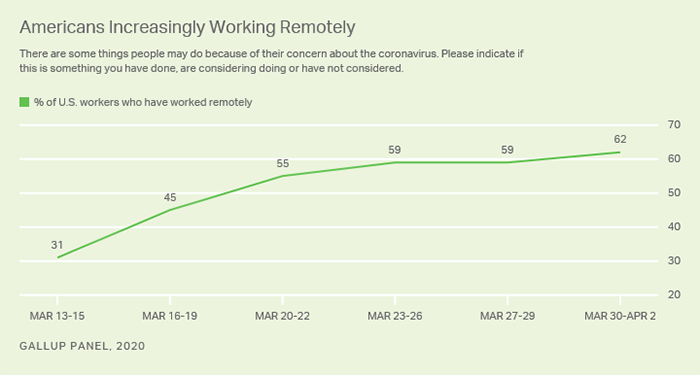
Increase in remote work among U.S. workers during the COVID-19 period. Gallup, 2020
In Korea, this kind of smart work — work from home and remote work — was originally introduced in a slightly different form. The well-known "smart work center" is one example. Office space for remote work is set up at a hub, and through reservations and registrations, workers come to the remote office at set hours to work.
There were many articles in the past, and even this year, promoting the operation of such smart work centers, especially at major Korean conglomerates. Large Korean telecommunications carriers and the systems integration affiliates of conglomerate groups have used these smart work operations as a good public relations channel for the company. The government also operates smart work centers, and civil servants and public institution employees can reserve a seat and work remotely at a government smart work center.
The benefits of a smart work center lie in saving commuting time for employees who work remotely and improving the efficiency of communication for companies whose business sites are physically separated.
What about smart work after COVID-19, when actual social distancing in the workplace has become important?
What caught my eye while looking through the introductions and bulletin boards of government smart work centers was a notice that, after the spread of COVID-19, only 60–70% of total seats are being operated to maintain distance between seats for social distancing. I doubt I am the only one who feels the irony in this.
Whether running smart work centers or running virtualization systems for remote work, the focus of interest in Korea seems to converge around the following:
"How do we check employees' attendance to prevent slacking?"
"How do we ensure that the productivity and engagement of employees do not drop?"
That being the case, Korean companies have a fixed list of features they always require in remote work solutions.
Personal attendance management and working-hours checks, continuous monitoring of work behavior (even periodically observing whether the mouse moves within a certain interval), and so on are all essential. The brief history in Korea of group-based remote work centered on smart work centers — introduced as if it could function as employee benefits and a quality-of-life upgrade — cannot be separated from this Korean sensitivity to attendance.
So does remote work — vulnerable to attendance management and surveillance — actually hurt labor productivity compared with the past?
The answer of course depends on the type of work and the industry, but research on the question offers some very interesting observations.
According to research based on a 2015 survey at a Chinese travel company, when call center employees were rotated through work-from-home, productivity for the at-home group rose by an average of 13%. The main drivers of this productivity gain were a reduction in break time and absences due to sick leave.
If a call center represents simple, repetitive work, there are also examples for non-routine office work.
The U.S. Patent and Trademark Office (USPTO), which has run a remote work program since 2008, found that patent examiners who shifted to remote work recorded a 4.4% productivity gain — without any drop in the quality of examination.
The U.S. Patent Office reviews and processes different patents in different regions of the country, and so it required offices for patent examiners in each region. By converting their work pattern to remote work — expanding the share of remote work from 46% in 2008 to 88% in 2018 — the office produced a roughly fivefold increase in real estate cost savings over that ten-year period from the reduced need for regional offices.
That said, several preconditions were needed to actually realize productivity gains. For employees performing similar job functions, geographic accessibility had to be guaranteed so that they could regularly come together to work — and only then did the productivity gain stand out clearly. This is interpreted as the effect of sharing job content with each other and learning from one another through face-to-face contact and shared space.
In other words, a certain level of in-person contact is still needed to spark informal learning effects and shared growth among employees (especially less experienced ones).
We may have built such efficient smart work infrastructure, but failed to actually improve productivity through it because of the prejudice toward in-person work and the familiarity with traditional ways of working mentioned above. So as we enter the smart work era — which has now opened wide whether we wanted it or not — what changes are required?
The 8% wage gap that workers said they would be willing to accept in the 2017 NBER study mentioned above can ultimately be interpreted as the cost of flexibility and autonomy.
To elevate the value of smart working — provided to employees — into the value the company provides to its people (Employee Value Proposition, EVP), this smart working has to be interpreted by employees as less micromanagement and more room for autonomous handling of work. Rather than expanding attendance management or surveillance, what matters is supporting trust in autonomous execution and smooth, work-centered communication.
To do that, what we should first do is build a flexible culture and structure organizations so that individuals can contribute autonomously through more agile units. In an organizational culture dominated by traditional vertical job levels, the chain of reporting cannot help but emphasize uniform thinking and lockstep execution rather than the distribution of work.
If your organization wants to experience productivity gains through smart work, you should first ask whether the work is grounded in diversity and creativity, and whether autonomous individual work and a culture of peer collaboration ultimately exist — and then actively introduce and practice them.
If you want to maximize contactless work efficiency through smart work, then both individual work content and organizational work — as well as status — have to be shared and visible in real time. Every means used when working in the same space — formal and informal communication, conversation, the physical sharing of documents — has to be replaced by an electronic means of sharing.
Solutions that support this had already been emerging before the COVID-19 era and have continued to be developed. Overseas, solutions like Slack, Teams, Jive, and Yammer have been used for messaging and the simultaneous sharing and history tracking of work content.
In Korea as well, messaging-app-based services such as LINE Works and Agit exist. In particular, work management solutions like Performance Plus provide Kanban-style work management, sharing, messaging, and the tracking of work behavior, reviews, and goal-evaluation linkage based on it.
The most critical task, of course, is shifting to a paperless work culture in which every kind of work is handled in a contactless way. Through that, social-network-based work handling can lift productivity even further.
According to Tsedal Neeley, a Harvard Business School professor on managing distributed teams, what has had the largest impact on employees' psychological state since the COVID-19 pandemic is the loss of organizational belonging that comes from the disappearance of informal encounters in the company — running into someone at the water cooler, the brief conversations that happen while picking up a cup of coffee in the office pantry.
To overcome this, she advises team managers to discover and apply as many virtual events through virtual contact channels as possible — happy hours, video coffee breaks, sharing lunch experiences, and so on. She also advises individuals that performing repetitive rituals helps maintain mental balance — for instance, dressing similarly to how you would for the office, keeping a commute-like rhythm, and engaging with coworkers in various ways.
Today's smart work has become a broad concern out of necessity triggered by the environment, but since it began with the unbounded growth of the infrastructure that makes smart work possible, smart work will continue to grow as technology advances.
As smart work experience accumulates, the volume of data documenting work will grow, and that volume of data will serve as good textbook material for machine learning. Through analysis of accumulated work data and outcomes, the era will arrive in which machines can answer which work behaviors, personal traits, and even lifestyle habits, collaboration patterns, and work-style preferences can maximize the work efficiency of an individual in a particular job.
Just as when AI plays Go far beyond what humans can grasp, even the people who created the AI do not know why a particular move was made — at some point, AI will reach a "singularity," and many areas of HR management like recruiting, evaluation, and assignment will start to be run more reasonably with the help of machines. This, of course, will be possible only when smart work experience has accumulated sufficiently.
Also, as hardware advances and wearables become widespread, and as connected workers begin to emerge, smart working will move beyond being a remote-work supplement for distancing and become essential in every production and office setting.
Questions about whether productivity can be maintained through smart work, whether attendance can be properly managed, or how to make up for the lack of in-person contact have already become outdated. The technology has already run far ahead in the journey toward smart work, but our perception is still walking in place.
We can be self-deprecating about how the slow spread of smart work comes from our own fixed mindset — "humans have always feared the unknown."
And we may still think that "if there is no certainty, technology and culture have to be sufficiently reviewed before being accepted." But once a new unknown disease emerged, smart work suddenly spread rapidly and is steadily proving that we can keep our work going — was that because our perception and organizational culture have matured, or because the human survival instinct kicked in?