
Related Solution
HCG HR Solutions
hunel · JaDE · talenx — we propose the right HR solution for your organization.

Solve Complex HR Challenges with HCG
Talk to our experts
Insights
V-nomics — set off by the V of "virus" — is becoming both prolonged and routine, and is reshaping the workplace. Statistics vary slightly, but close to 80% of workers experienced remote work, including work from home, and video conferencing for the first time after COVID. Workplace flexibility, which began with the establishment of the 52-hour workweek, is now expanding from time into space.
Changes in the work environment inevitably accelerate the need for digital technology. Beyond simply enabling easy remote access, the demand is for infrastructure that can technically manage the entire process and outcome of work. The people who make up the workplace are also the consumers driving the economy.
After COVID, e-commerce spending grew two- to fivefold by country. For employees who have intensively experienced economic activity through the online, app-based, and platform-driven "contactless" economy, digital lag in the workplace translates directly into lag in the employee experience.
In a workplace marked by spatial-temporal flexibility and a digital work environment, HR faces a new challenge: the doubt about whether productivity is improving — or even being maintained. The answer to this challenge lies in data. Until now, HR has not been able to clearly define what "data-driven HR" means, because the data itself was thin. The diversification of the workplace will inevitably bring with it a diversification of the data we have not had access to before.
As workplace infrastructure changes, the definition and management of talent is also changing. Whenever companies overcome a constrained business environment and try new things, they hire talent again — but it is not necessarily the same people. For the same task, they expect to solve it through different capabilities and skills, and they look for the talent that fits. Internal-talent moves like reskilling, upskilling, and job crafting will also begin in earnest.
In areas where the industrial ecosystem is shifting rapidly — automotive, biotech, IT — the talent portfolio itself needs to be restructured. Even when the talent pool is the same, the capabilities built on physical, in-person relationships need to be replaced.
We need to focus on a kind of soft skill: the "relationship-building" capability of collaborating, communicating, and exerting influence on top of digital understanding, along with the emotional intelligence to maintain one's own balance in the face of unfamiliarity.
What accelerates this is generational change, represented by Millennials and Gen Z. They are not only digitally native but are also "known" to value present rewards over expectations of an uncertain future, and to show high loyalty to things aligned with their own values and beliefs — green consumption, "meaning out," and so on. HR policy that embraces this new generation is now a non-negotiable. As several socially impactful cases show, the legacy of evaluation and reward systems will continue to face challenges.
Redefining talent and breaking it out by generation ultimately leads to personalized HR. Customizing by job characteristics, by generation and role group, and the flexible management of individual employees through expanded on-site discretion — all of these are tied to the same direction. And interest in leadership, which is the core of all this change, will continue. HR actions are needed to monitor and intervene as long-accumulated success stories, perspectives on work, and the language and technology used by leaders converge with — or collide with — these new changes.
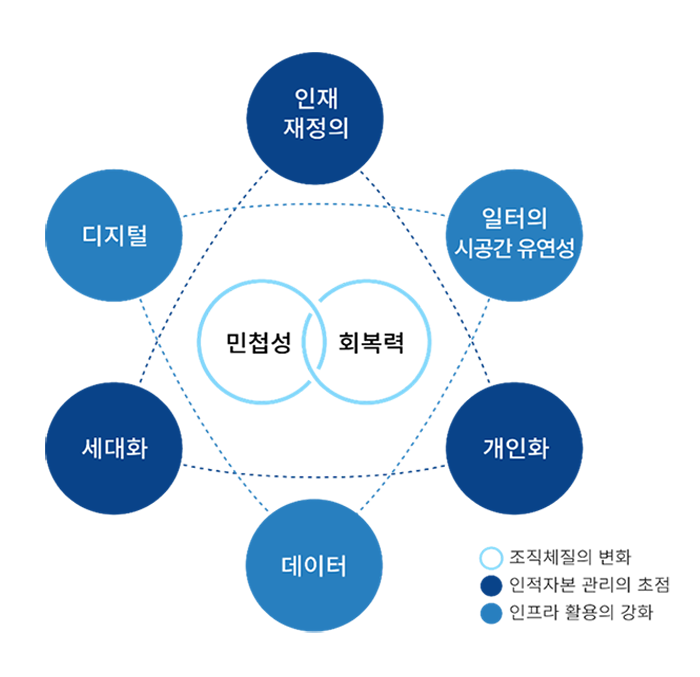
I have summarized the second-half HR keywords for this year as follows: digital infrastructure, spatial-temporal workplace flexibility, stronger use of data, and on the policy side, redefining talent, generational issues, and personalization.
To be honest, parts or all of these forecasts have been heard year after year, and going back several years, the broader picture is similar.
The novelty of "New Normal" is no longer all that new — to the point where the term "Next Normal" has emerged a step beyond it — but the substance is not very different.
What is different is "speed." The more capability and resources are in place, the faster the speed. With those conditions equal, what determines the speed is "need." Especially when the need is felt as urgent and tied to survival, that pace accelerates. Change driven by necessity is faster than change driven by desire. Many of the HR trends that will continue through the second half of this year and beyond have been underway for some time, but COVID-19 is accelerating them — and the bigger force of change is that people's mindsets are shifting significantly.
In his famous book on the Fourth Industrial Revolution, Klaus Schwab pointed to three pieces of evidence that the change had broken from a linear extension of the past: Velocity, Breadth and Depth, and System Impact. He predicted that change would unfold exponentially rather than linearly, that we would face a paradigm shift of unprecedented scope and depth, and that it would entail a transformation of companies, industries, and even society as a whole. This observation, which seems to fit the present and the foreseeable future, is already five years old — and shocks like a pandemic were nowhere in the predicted range.
As we experienced during the previous financial and fiscal crises, the predictions of calculated risks or avoidable risks alone can no longer guarantee competitiveness. Just as the global supply chain was paralyzed in an instant, what we have long believed to be the standards of HR have to be rethought at their foundations. The conversation around organizational constitution will therefore concentrate again on agility and resilience. But the speed at which this happens has to be faster than ever.
Responses to whether new workplace environments like post-pandemic remote work have improved or maintained employee productivity are somewhat mixed. The British research firm Statistica reported that 73% of respondents felt more efficient, while a survey by The Manifest reported that only 30% of respondents said their productivity had improved. Many experts attribute this difference to the level of effort and readiness around digital innovation.
Organizations that had actively introduced and prioritized digital tools for collaboration and performance management are more likely to have absorbed the rapid change in the work environment and produced better results. The fact that the public and financial sectors — strict on regulation and security — generally have a harder time maintaining productivity through such transitions can be understood in the same context.
The gap in invested infrastructure cannot be overcome in an instant. So each company's own customized HR infrastructure build-out — already underway or planned — needs to accelerate further in the second half. Alongside that, to effectively offset the gap in pace of change, it is worth strategically choosing to strengthen the connectivity of digital tools. Make active use of specialized cloud platforms for specific purposes — collaboration, communication, performance management, attendance and payroll, video conferencing — a kind of "category killer" service approach, and connect them. Just as companies use omnichannel to maximize customers' online and offline consumption experience, providing and connecting tools optimized for the new workplace environment can rapidly raise infrastructure readiness.
One client using our performance management platform is now attempting predictive analytics — high-performance factors, attrition risk, and Organizational Network Analysis (ONA), among others — based on a year of user data. This will let them see the truly 360-degree employee profile and use it for agile HR decision-making. Company-specific data like this cannot be obtained from global standards, and at minimum, it would take a year to catch up.
The speed gap will only grow from here.
Daily life under the recent pandemic carries simultaneous risks: failing to capture employees' contributions and growth experiences in time, or conversely, failing to block negative externalities like free-riding. On top of that, as the lines between work and home blur, the stress employees have experienced from the uncertainty is likely to continue for some time. There is research showing that more than 70% of employees experienced burnout for these reasons over the past year.
In a situation where hopes for a return to daily life and downside risks coexist, HR needs to prepare to strengthen its resilience. There should be more attempts to run multiple programs within a single company, with focus differentiated by business, job, talent market, and work environment. These transitions are complicated by collisions with existing programs, and the variety of choices brings the difficulty of decision-making with it.
The philosophy, however, has to be simple. Keep the eye fixed on whether the result of the change strengthens or restores trust with employees. Transitions that strengthen fairness, care for employees, organizational capability, and even the company's social responsibility build trust as an asset and raise resilience.
It is also important to create an environment where HR can focus on and lead this change. Operational work that has historically required high transaction costs — administration, payroll processing — should be specialized externally, freeing HR to focus on capturing changes in the workplace and in talent.