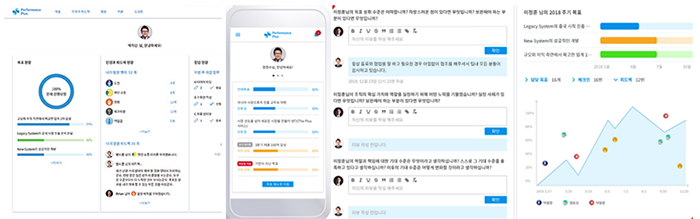

Related Solution
HCG HR Solutions
hunel · JaDE · talenx — we propose the right HR solution for your organization.

Solve Complex HR Challenges with HCG
Talk to our experts
Insights
Innovating performance management has been one of the biggest currents driving HR change over the past 10 years.
To coexist with a new generation that values meaning, enjoyment, and growth in work — in workplaces where the way work is done has changed — this current will continue for the foreseeable future. Unlike in the past, every recent HR change requires a technology solution combined with IT. Programs that assume offline, in-person activity and filling in paper forms are gradually disappearing. The time and cost required to maintain procedural practices, and the difficulty of guaranteeing consistent operation, are too high.
Naturally, the trend in the use of new performance management solutions is being led by the trend of preceding policy change.
What matters as much as using new tools and technologies is making employees feel valued in this process — both in improving their performance and in participating. Technology is a blessing, but without smart usage, the result is just a waste of resources.
First, here is a summary of where global companies are focusing the change in their performance management.
· Focusing on employees whose performance contribution is unusually high or, conversely, falls significantly short of expectations. This shift in focus removes the need to make microscopic distinctions and queue up the many average performers.
· Many companies use solutions to gather and analyze performance information in real time. Through this, they accumulate richer, more objective data and use it for performance improvement.
· Companies are gradually moving away from the mechanical link between performance review results and rewards.
· Most importantly, real-time performance information analyzed on the basis of facts and evidence is focused on how to apply it to the current situation, rather than on evaluating the past.
Let's look at a few cases of well-known global companies that have led this kind of performance management innovation, and summarize the trends in new performance management solutions.
In 2012, Adobe introduced a new performance management solution called "Check-in." It scrapped its rating-centric system and ended the practice of having employees recognized for their performance through comparisons with their colleagues. The hallmark of Check-in is giving managers and employees more autonomy when deciding goals. Without being bound by annual practice, it provides functions to add goals as needed and manage their progress. In addition, ongoing real-time feedback is managed through the system. Periodic monthly or quarterly conversations with managers thoroughly exclude paperwork, and check-in centers on conversations about three themes: expectations, feedback, and growth and development.
The productivity gains from this dramatically reduced the time spent on performance reviews, and just from the simplification, managers are reported to have saved a total of 80,000 hours per year. Communicating more transparently and openly through the solution improved both employee trust in the system and engagement. 78% of employees feel that their managers are open to their opinions, and through process transparency, voluntary attrition has dropped by more than 30%. Managers also report that tough calls and difficult conversations with employees have become easier, and that their abilities have improved.
Microsoft, which had experienced what some called "the lost decade" of declining management performance through unhealthy internal competition and lack of team cohesion, scrapped the bell curve — the symbol of forced ranking — in 2013 and introduced a new performance management system called Connect. The system focused on encouraging meaningful discussion and collaboration and on driving performance through learning between employees. Managers no longer needed to label a certain distribution of employees as the low-performance group, and the transparency of the system also helped prevent discriminatory behavior driven by unconscious bias. Going further, it provides flexibility in compensation and recognition, allowing distinctive contributions to be rewarded in a timely way.
In 2015, GE scrapped the forced relative distribution ("rank and yank") practice that it had popularized worldwide. The new solution, called PD@GE, is centered on letting employees set short- and long-term goals (priorities) that are more useful to themselves, have more frequent conversations with their managers (touchpoints), and exchange real-time feedback (insights) at any time.
Through this mobile application, managers can track the company's evolving performance definitions and goals as they change throughout the year. Feedback requests and responses are also easily recorded and accumulated.
Through transparent feedback that no longer relies on anonymity, trust between employees and managers has grown, and during the early period when the new solution began to be used, productivity is reported to have improved fivefold thanks to future-oriented real-time feedback. The biggest concern during the pilot period — covering more than 30,000 employees — was meritocracy. There was concern that a system that looked transparent and horizontal might inadvertently weaken the recognition and rewards previously given to high-contributing, high-capability employees. But managers came to recognize that, even without ratings, they could differentiate compensation-related decisions through more frequent contact with employees and the increased volume of feedback compared with the past.
Beyond these widely known examples, many global companies are actively using performance management solutions. Some have their own systems through economies of scale, while others use cloud solutions on the market with strong functionality and distinctive features. Recent performance management solutions or applications share several core characteristics.
Social media's approach has already proven very useful for brands trying to communicate with consumers. The same effect is being demonstrated in the relationships between company and employee, manager and employee, and among employees themselves. This network effect promotes not only cultural relationships like communication and teamwork but also the communication needed to track and improve performance. New performance management solutions are focused on building and expanding these networks.
Performance management innovation involves change on multiple fronts, but if you had to pick one core, both the start and the end are feedback. One of the unique advantages of recent performance management solutions is that they can deliver performance-related feedback anytime and anywhere. Through this constant function, both managers and employees can naturally carry out the procedures needed to recognize and fix problems. They can also more easily run the annual evaluation process based on accumulated feedback data.
As the pace of change accelerates and uncertainty grows, the validity of annual goal management is being continuously questioned. Especially as knowledge-based value becomes a more important goal in business performance, defining employees' goals through a few quantitative indicators alone — as in the past — becomes harder. Performance management solutions must be able to create and manage dynamic goals. The result-level achievement and weighting are not what matters; what matters more is which goal is needed at this very moment. Employees should be able to update their own goals as time passes, and the company or manager should also be able to ask for the right goals at the right time. Recent solutions focus on user-driven goal management and improvement, allowing goals to be updated flexibly.
Powerful performance management solutions also include functions to recognize employees' contributions — large and small — at a social level. The benefits of this social recognition are broad — for employee participation and engagement — and narrower — for performance measurement. Letting anyone exchange and surface moments of contribution that a manager alone could not observe or capture, within a corporate social network, is one of the powerful advantages a solution provides. The Millennial generation, which is becoming dominant in workplace demographics, has a strong desire for recognition and is comfortable participating in and sharing such moments. They find meaning in not only consuming information but also creating and circulating it, which makes the strength of public recognition in the workplace even more pronounced.
It is still common — both in the past and now — for a performance management system to contain no meaningful records. Goal and metric items, scores or ratings, and a few qualitative comments cannot represent a single person's record.
Recent performance management solutions have a strong function as a repository that accumulates feedback, work history, goal management check-ins, and even career development progress. Some also track mutual recognition and change among colleagues, including social recognition and 360 feedback. Going further, some integrate task management and collaboration into a single performance management solution, eliminating the fatigue of "work over here, management over there." These records' artifacts help carry out accurate evaluation as time accumulates, and through insightful performance analysis they can be linked to development and promotion.
The more information you manage and accumulate through a performance management solution, the more analytical perspectives become possible. There is also the advantage of automating and structuring results that previously could only be obtained through manual and repetitive work. Tools are emerging that allow you to comprehensively review not just the final result of a goal but the journey of achievement, the moments of recognition recorded along the way, and the history of collaboration an individual has performed and how it relates to the goal.
Through this, you can gain new insights that were previously inaccessible. A solution originally created to escape relative-rating, ranking-based performance management is now, conversely, contributing to making relativization and ranking less meaningful. Reports related to performance evaluation can also be generated under this multi-dimensional perspective.
Customer experience has long drawn attention. Now the new trend in performance management solutions is employee experience.
This umbrella term refers to every interaction an individual has from the moment they join a company to the duration of their employment. It includes the culture they encounter, the environment in which they work, the recognition they receive, the colleagues with whom they work and socialize, and everything they can get from the workplace. Solutions that encourage more frequent collaboration, feedback, and check-ins deliver a high level of employee experience. When HR data — recorded as outcomes like evaluation results over the years, organizational affiliation and movement history, and career details — is connected with employee participation and perception and the changes in mutual relationships among employees, it becomes powerful big data. The scope of performance management solutions is now expanding beyond simple performance measurement to become a tool that manages organizational culture and individual experience.
Recent performance management solutions help us understand what is working well in the organization and — more importantly — what is not. This of course also helps with more insightful decision-making. Real-time performance management solutions and applications can collect a variety of performance activity data that previously could not be collected, and as a result help carry out annual performance reviews more accurately. Managers no longer need to feel the tension and stress of trying to remember every detail of an employee's performance. That time will be used to enrich meetings with team members through data and to have more meaningful coaching conversations.