

Related Solution
HCG HR Solutions
hunel · JaDE · talenx — we propose the right HR solution for your organization.

Solve Complex HR Challenges with HCG
Talk to our experts
Insights
Apple co-founder Steve Jobs reportedly said, after running more than 5,000 hiring interviews, that "top talent delivers 50 to 100 times more than average talent."
In truth, the talent Jobs was describing is closer to the 0.01% natural Genius, whereas when companies talk about "top talent," they usually mean the high-potential 3–5% at the top of the organization.
So how much of a difference is there, really, between top talent and average talent? Overseas research has found that high-potentials (Hi-Po) deliver 400% higher productivity than average talent, lift organizational performance by 15%, and also carry a 400% higher replacement cost.
Companies have recently been through the eras of the Great Resignation and Quiet Quitting. Top-talent attrition is expected to have risen somewhat during this period. How competitive, exactly, is the top-talent compensation program at Korean companies right now?
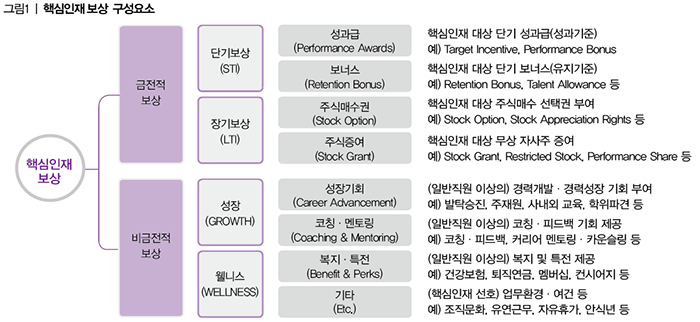
<Figure 1> shows our own Top-Talent Compensation Framework and Components. Top-talent rewards break down broadly into monetary and non-monetary rewards, and are classified into eight items across the two domains. Using this framework, let's compare top-talent compensation at global leaders versus Korean companies.
The top-talent compensation of global companies, whatever the level or ratio, shares structural features with executive compensation. The foundation is competitive base pay aligned with market value. Base pay (fixed compensation) is the single most effective lever for attracting and retaining talent, so it is offered at a market-competitive level from the point of hire,
and if the candidate holds a role or skill that is scarce in the market (Market-Valued Job & Skills), additional premiums are considered.
Along with base pay comes a Short Term Incentive (STI), tied to the top performer's short-term performance.
Unlike Korean companies, global firms tend to run performance bonuses on absolute evaluation and individual goal attainment, making it easier to deliver cash rewards proportional to an individual's actual performance. On top of that, a Long Term Incentive (LTI) rewards long-term performance and continued tenure. It is paid out as a signing bonus at the point of hire and as a retention bonus for continued service. Long-term incentives often include stock grants, performance shares, and restricted stock — all widely used to encourage long tenure and sustained performance.
※ For reference, stock option plans have seen declining use overseas as well, because they can create dramatic rewards unlinked to individual contribution (and thus encourage departure) or turn out to be worthless (impossible to exercise). Actual stock ownership, by contrast, is seen as effective at building a sense of belonging to the company and encouraging long tenure, and its use is on the rise.
For top talent, non-monetary rewards can be at least as important as monetary ones. Once a certain threshold of monetary reward is met, what matters more to top talent may be things like "working at a top company with the best colleagues" or "achieving career aspirations at a top company."
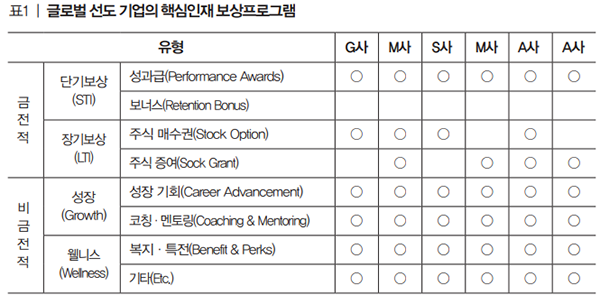
<Table 1> summarizes well-known top-talent compensation programs at leading global companies, and offers several takeaways.
A Vehicle Mix — combining multiple short- and long-term incentive programs for top talent — aligns the company's, shareholders', and employees' value and interests, and offers differentiated, dramatic reward opportunities compared with general employees.
Examples like GE's Corporate Audit Staff (CAS), which places top talent on audit assignments that let them see across the entire company, or Apple's Top 100, which selects 100 core employees to attend the annual company-wide strategy meeting, give top talent the chance to work with the very best and to receive priority and differentiated career growth opportunities. These are core
reward and motivational levers.
(Given that social safety nets like medical insurance and retirement pensions are relatively weaker in many overseas markets) expanded family insurance coverage and enhanced retirement plans are important retention factors for top talent.
In Korea, too, top-talent management has been practiced since Samsung's "Talent Management" success story, but the level still falls short of global leaders. Competitiveness on the retention side — through monetary rewards in particular — is especially low.
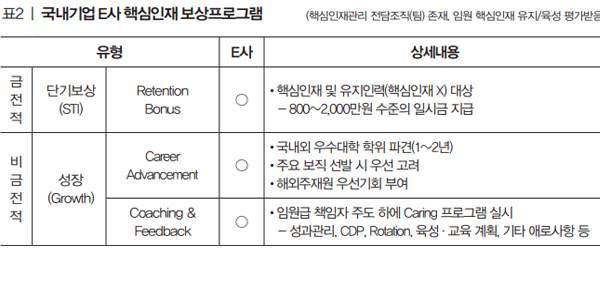
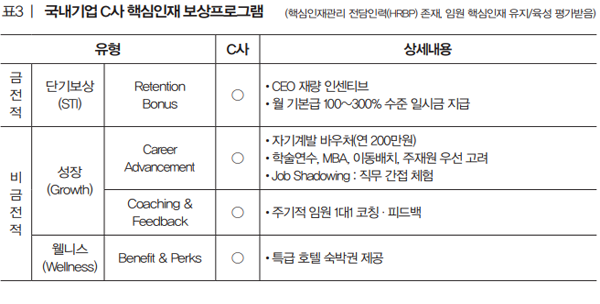
<Table 2> and <Table 3> present top-talent compensation (retention and development) programs at Company E and Company C, two representative Korean firms.
Company E focuses on growth and development programs, along with small short-term cash rewards, and runs the program largely as a caring program led by the responsible executive. Company C similarly focuses on differentiated growth programs on top of modest monthly-salary-level short-term cash rewards,
with some differences in select benefits and perks.
Even the companies shown here are major Korean conglomerates running relatively systematic top-talent compensation, and are on the stronger end. Typical Korean conglomerate top-talent rewards often amount to (1) ensuring a minimum rating of at least B in performance evaluation, or (2) a small + α on top of base-pay raises — and little more.
Just a year or two ago, it was not uncommon to hear about top talent leaving Korean conglomerates for Pangyo (Korea's tech cluster). (Some of that, of course, is now flowing back.)
As this comparison shows, top-talent compensation at Korean conglomerates is still modest relative to global leaders — and in some cases is even less competitive than what certain Korean tech firms and startups offer.
As the comparison between global and Korean companies makes clear, Korean firms' top-talent compensation and retention policies are significantly less competitive than their global counterparts. That said, these Korean cases and practices are in their own way a product of real reflection on the local context. Three reasons help explain why it is hard for Korean companies to differentiate and elevate top-talent compensation the way firms abroad do.
As the Korean proverb "My cousin buys land and my stomach hurts" suggests, Koreans tend to compare themselves to others. For that reason, many companies prefer to run top-talent management quietly rather than make it visible, and they worry that deep differentiated rewards will demoralize the 95% who are not top talent.
In Korea, awarding equity-based compensation requires board approval and public disclosure. That process reveals the existence of top talent — something many companies had been keeping quiet — and the burden of explaining and justifying this to the board and to employees is often seen as heavy. (As a result, cash is used more heavily.)
Most Korean companies still do not grant equity-based compensation or long-term incentives to executives, and even when they do, the gap between executive and employee pay is not very large. This makes it hard to offer employees equity-based long-term incentives, and even when cash is used, it is hard to make it dramatically generous given the executive-to-employee ratio.
※ In 2021, the CEO-to-employee pay ratio at S&P 500 companies in the U.S. was roughly 324:1. In major Korean conglomerates, the ratio tends to feel closer to around 10:1, and entry-level executive total compensation typically lands in the range of ₩200–500 million. Given that spread between executive and employee pay, the room to differentiate top-talent compensation is very narrow.
Fortunately, for many members of the top-talent cohort, compensation functions as a hygiene factor more than a motivator.
A global survey of top talent (Center for Creative Leadership: High-potential Talent — A View from Inside the Leadership Pipeline) found that growth and development (38%) mattered far more than differentiated rewards (11%).
For most top talent, differentiated rewards carry meaning as a symbol — "the company recognizes my value." What top talent actually values more tends to be recognition and encouragement, growth and opportunity, autonomy and authority, and colleagues and culture.
Of course, for some people, dramatic compensation will be the single most important motivator. It is therefore worth prioritizing personalized experiences for each individual Hi-Po. The attention and discretion of the responsible executive — and the existence of a dedicated team — can help enable that.
※ According to a 7 Employee Typology analysis (HCG's proprietary methodology, which classifies employees into seven types based on what they most value at work), general employees most value the balance between pay and workload (Negotiator), while top talent tends to place greater weight on enjoyment of work (Adventurer) and personal growth (Alpinist). (That said, what specific top talent prioritizes varies considerably across companies and individuals.)
Consider a few examples. If a top performer, A, is struggling with childcare, flexibility in work arrangements and time off may be far more effective than additional compensation. If B is struggling with an incompetent supervisor and insufficient authority, moving them to a different team or empowering them as a leader with full authority may be the best answer.
If C is suffering from burnout, paid leave or counseling may be what is needed. (Given that top talent tends to be assigned challenging work and tends to push themselves hard, burnout is probably quite common.) None of this is something a system can solve on its own — it can only be addressed through individual attention and care.
In conclusion: top-talent compensation at Korean companies is fairly uniform across the board, so if the competition is another Korean company, "opportunity and growth" and "attention and care" may be more meaningful forms of reward. But if the competition is a global company, current Korean top-talent compensation simply is not enough to compete.
In that sense, IT and tech companies like N, K, and T are a step ahead on top-talent compensation, and Korea as a whole is expected to gradually move in the same direction.