Related Solution
HCG HR Solutions
hunel · JaDE · talenx — we propose the right HR solution for your organization.
Solve Complex HR Challenges with HCG
Talk to our experts
Insights
It has been several years since employee experience (EX) was introduced as a core theme in HR. Despite considerable HR effort over that time to shift perspective — treating employees not as "objects of management" but as "subjects of experience" — we are still falling short.
According to a Gartner survey, only 13% of employees are satisfied with their experience, and only 29% say HR truly understands their needs.
Because the very concept of "experience" is inherently broad and expandable, clearly defining the scope, attributes, components, and application area of employee experience is not easy. Since Jacob Morgan proposed culture, technology, and physical space as the three environmental elements of employee experience, efforts have continued to segment employee experience
into ① social (relationships), ② work, and ③ organization (McKinsey), or to define it around the emotions employees actually feel — ① belonging, ② purpose (meaning of work),
③ achievement, ④ happiness, and ⑤ vigor (IBM).
Whatever the framing, the category of employee experience we need to understand and think about is, in the end, a concept that covers all the emotional elements an employee experiences as they form various work-related relationships within the physical environment of the workplace.
Despite all the attention employee experience has drawn, the work of tying it directly to business strategy and building the technology environment needed to implement it still appears to be lacking.
In a recent Towers Watson survey, 35% of participating companies had only set up a strategy and technology plan for employee experience, and 26%
had no plan at all — not for strategy, not for technology. On the other hand, leading companies that are paying attention to employee experience and investing in it are rolling out a variety of programs around the major events of the employee lifecycle, from hire to exit.
Employee experience begins at recruiting. The use of new technologies like NLP and VR interviews not only makes processes more efficient but also delivers a forward-looking, positive experience of the company for candidates.
Hilton uses AI-driven résumé screening to free up time for more focused interviews, and uses chatbots to respond instantly to candidate questions — giving applicants a good experience of the company even before they become employees. According to Hilton's own research, its hiring speed improved 85% compared with the past, and attrition fell 4%.
The effort to deliver a positive experience of the company extends even to candidates who were not hired. Most candidates want feedback from companies "to plan their next move or shore up their weaknesses," and there are many cases where candidates' perception of a company shifts after going through its recruiting process.
Company K sends a message of sincere thanks to every rejected finalist. The message is not just thanks for applying — it also includes the strengths and weaknesses observed in the interview. Company K says this both gives candidates practical help and sustains a positive image of the company.
Welcome Kits have recently become popular at Korean companies. The company prepares a gift that carries its welcome and expectations for the newly official employee, and the recipient experiences, from day one, the satisfaction of being recognized as an important member of the organization.
It is most common to assemble work-related items — fountain pens, notebooks, mugs — but some items have become symbolic in their own right, like Company S's gold-embossed business cards.
Company L uses recycled fabric to carry its corporate value of carbon neutrality. More and more companies are thinking about distinctive kits that express their own identity.
The issue is that in the onboarding stage — where the goal is to quickly integrate new hires, share a growth vision, and build confidence — a welcome kit is, by itself, a one-time event. Korean companies often stop at offering mentoring during onboarding, but leading global companies are putting effort into more meaningful processes that deliver positive experiences to new hires.
A classic example is Twitter's "Yes To Desk" program. Literally, there are 75 touchpoints from offer acceptance to a new hire sitting down at their desk — from seat assignment to a meal with the CEO to training on work systems and tools — all designed to make a new hire's first day a special experience.
Zappos takes it a step further: if an employee withdraws after going through onboarding, the company pays $2,000, no questions asked.
If new hires feel they do not fit Zappos's culture, they can walk away freely.
Work-from-home under COVID-19 shook up the long-standing practice of gathering in an office to work.
Today, the work environment — including physical space — is one of the most important factors candidates weigh when choosing a company. Offering an optimal work environment is now seen as one of the most compelling experience elements a company can use to appeal to its people.
Reflecting this, Company N plans to launch its "Connected Work" system from July, letting employees periodically choose between full remote work and a hybrid arrangement with at least three days a week in the office.
Its affiliate, Company L, has taken things even further by allowing overseas remote work within a four-hour time difference — a relatively dramatic setup.
The growing popularity of "workation" (work + vacation) — working and resting in natural or unhurried surroundings — is another part of companies' effort to deliver positive experiences in the work environment.
Alongside these fundamental changes in the work environment, companies are also actively introducing the technology needed to support it. Employees want always-on access to the optimal tools for their work, and when that technology environment falls short, they leave in disappointment.
That is exactly why so many companies are now rapidly adopting basic collaboration tools like Slack and Teams — along with digital performance management tools (online meetings, real-time feedback) essential for remote work environments.
On compensation and benefits, many companies are deploying a variety of strategies to appeal to the MZ generation, which now makes up a significant share of the workforce.
Company S changed the subject of its free medical checkup benefit from "the employee and their spouse" to "the employee plus one family member" — reflecting a generation for whom marriage and having children are no longer givens.
Company P introduced a distinctive benefit: a "home cleaning service" delivered once a month.
The attitude a company takes at the end of an employee's career also matters. Giving departing employees a good exit experience is the best way to brand a company's reputation,
and it helps with retention as well, since it plants the perception — among the people who remain — that the company respects its employees.
Going further, careful analysis of why people leave gives companies deeper insight into the elements that shape employee experience — organizational culture, employee behavior, and hidden organizational issues.
Netflix has a distinctive practice called the Postmortem e-mail. It is a message a departing employee sends to the colleagues they worked with, covering
① why they are leaving, ② what they learned at the company, ③ what they felt was lacking, ④ what they plan to do next, and ⑤ Netflix's own position.
The employee's direct manager and HR both participate in preparing the final version, so it is not purely one-sided.
The company gets to diagnose current issues, and the departing employee feels respected in the formal communication process. It is seen as a program that benefits both sides.
Recently, many companies use "positive employee experience" as the rationale for individual programs. But examples of companies that have concretely defined their own, distinctive employee experience and aligned it consistently across their entire policy set are very rare.
In Korean companies in particular, most are still at the stage of just beginning to manage specific events — hire, onboarding, exit.
Those are meaningful starting points for employee experience management, but from a full lifecycle perspective, most of them are one-off events. Approaches to the relational and environmental elements that make up the majority of day-to-day work life are still underdeveloped — a gap worth noting.
If this is on your mind, the following recommendations may be useful.
Employee experience is sometimes compared to a "Journey" — the path an individual travels through a workplace. Within the full flow of the employee lifecycle, each experience may be
independent, but at the end of the journey there is only one thing: a single, composite, integrated experience.
For that reason, HR needs to prepare storytelling that employees can resonate with — about what kind of positive experience the company hopes to deliver all the way from hire to exit.
And this storytelling has to be grounded in each company's own unique values to draw out real resonance.
A patchwork of generally positive experiences that are disconnected from the values the company is pursuing will not move employees.
IBM is a good example of a virtuous cycle: the corporate value of digital innovation is transmitted into the employee experience (AI recruiting, chatbots, e-learning, remote work tools, etc.), and the employee experience in turn becomes the user experience and is delivered back to customers.
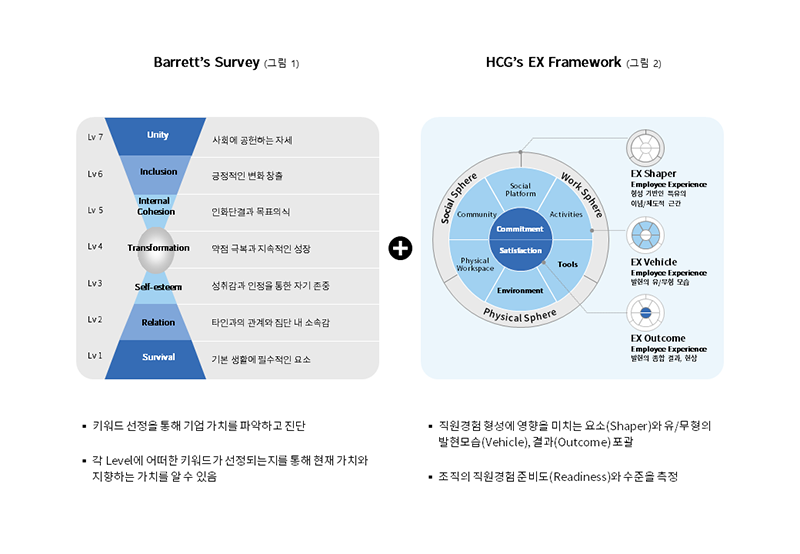
If you want to understand your own company's unique "values," I recommend starting with a diagnosis like the Barrett's Survey, which helps you intuitively grasp both the direction of the company's values and how they actually show up in reality. (See Figure 1.)

What makes employee experience different from previous models, at its core, is a thoroughgoing bottom-up approach. An approach where the company tries to "design" positive experiences for employees — however good the intention — is likely to fail.
A recent example: when Company K shifted to permanent remote work and tried to require always-on voice connection and mandatory in-person meetings, it ran into employee pushback — a clear lesson in how important it is to "listen" to employees.
Employee experience diagnostics should also move away from the old company-centric goal of "inducing engagement" and instead newly define and diagnose — thoroughly from the employee's point of view — the elements, manifestations,
and results that shape experience. (See Figure 2.) Along with regular diagnostics, it is also desirable to proactively provide and manage internal communication tools and channels through which employees' voluntary opinions can flow.
As this suggests, employee experience can be everything in HR — precisely because the concept is so broad. And paradoxically, for the same reason, it can also be seen as having no clear substance.
The only way to concretize a positive experience that employees can really resonate with is to build an experience framework unique to the company, grounded in fundamental reflection on the values the company is pursuing, tied together by consistent storytelling.